Digital Heating Optimization: Efficiency Through the Digital Twin

Smart Heating Control in a Multi-Family Building with Commercial Units
How can a building constructed in the 1980s be operated energy-efficiently and digitally controlled today – during ongoing operations and without extensive structural modifications? A residential and commercial property owned by Gewobag in Berlin-Rudow demonstrates how intelligent technologies such as the digital twin enable measurable energy savings.
Through data-driven, predictive control, not only is energy consumption significantly reduced, but occupant comfort is also substantially improved. Without the need for complex structural interventions, existing systems can be intelligently interconnected – a sustainable step toward climate-friendly building operations.
Location: Berlin-Rudow, Alt-Rudow 12357
Building type: Multi-family residential building with commercial use
Year of Implementation: 2022
Heated area: 1,800 m²
Energy Savings: 27%

Initial Situation
The building in Berlin-Rudow is a typical multi-family property from the 1980s with 12 residential units and several commercial units. Until recently, it was heated by a central gas condensing boiler (120 kW) supplying two separate heating circuits: one for the apartments and one for the commercial spaces.
The heating system was technically sound. However, it operated according to the traditional principle of supply-based heating rather than demand-based control: heat provision followed a fixed heating curve and rigid schedules – regardless of whether heat was actually required.
The result: stable but unnecessarily high energy consumption, leading to avoidable cost increases for all parties as well as unnecessary environmental impact. Replacing the system was not an option – too costly and too complex. What was needed was a solution that works with the existing infrastructure – not against it.
The Solution: Digital Retrofit Instead of Costly Refurbishment
Measures & Implementation
In 2022, the owners opted for the digital optimization service from KUGU. The objective was to control the existing system more intelligently –without structural modifications and without high upfront investment.
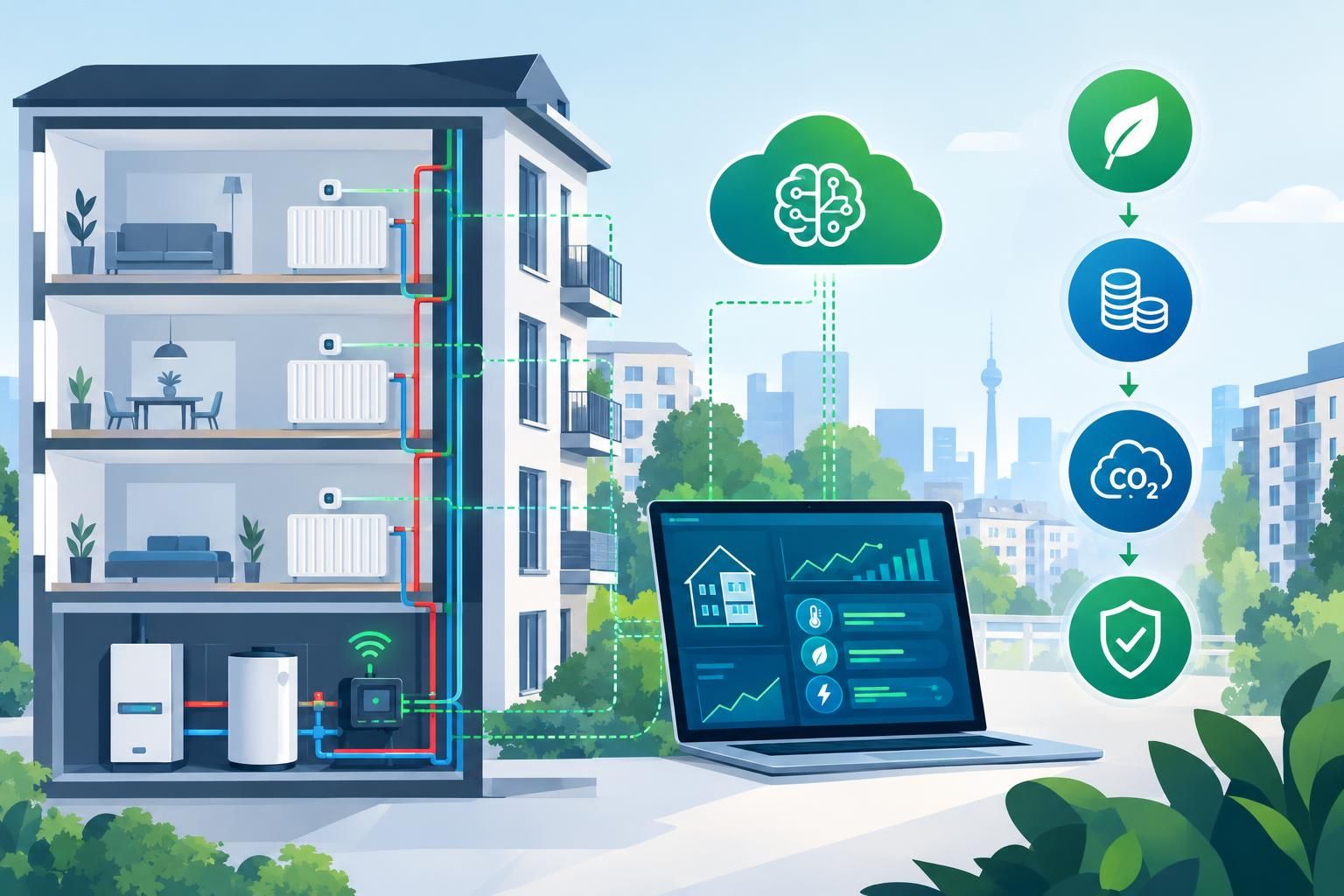
The chosen approach: a digital twin, a data-driven virtual representation of the building that precisely simulates its thermal behavior. Based on live measurement data, building structure, and weather forecasts, a digital model is created that continuously learns and dynamically adapts. This model forms the basis for predictive heating control that is continuously aligned with demand, weather conditions, and building behavior – fully automated and in real time.
- Installation & Commissioning
The heating system and existing technical components (controllers, meters, sensors) are digitally connected – simply and without structural intervention. An IoT gateway and only a few sensors are required. If necessary, a control box is installed to connect the gas boiler and control system. The solution is largely independent of system age and manufacturer and compatible with nearly all common heating systems.
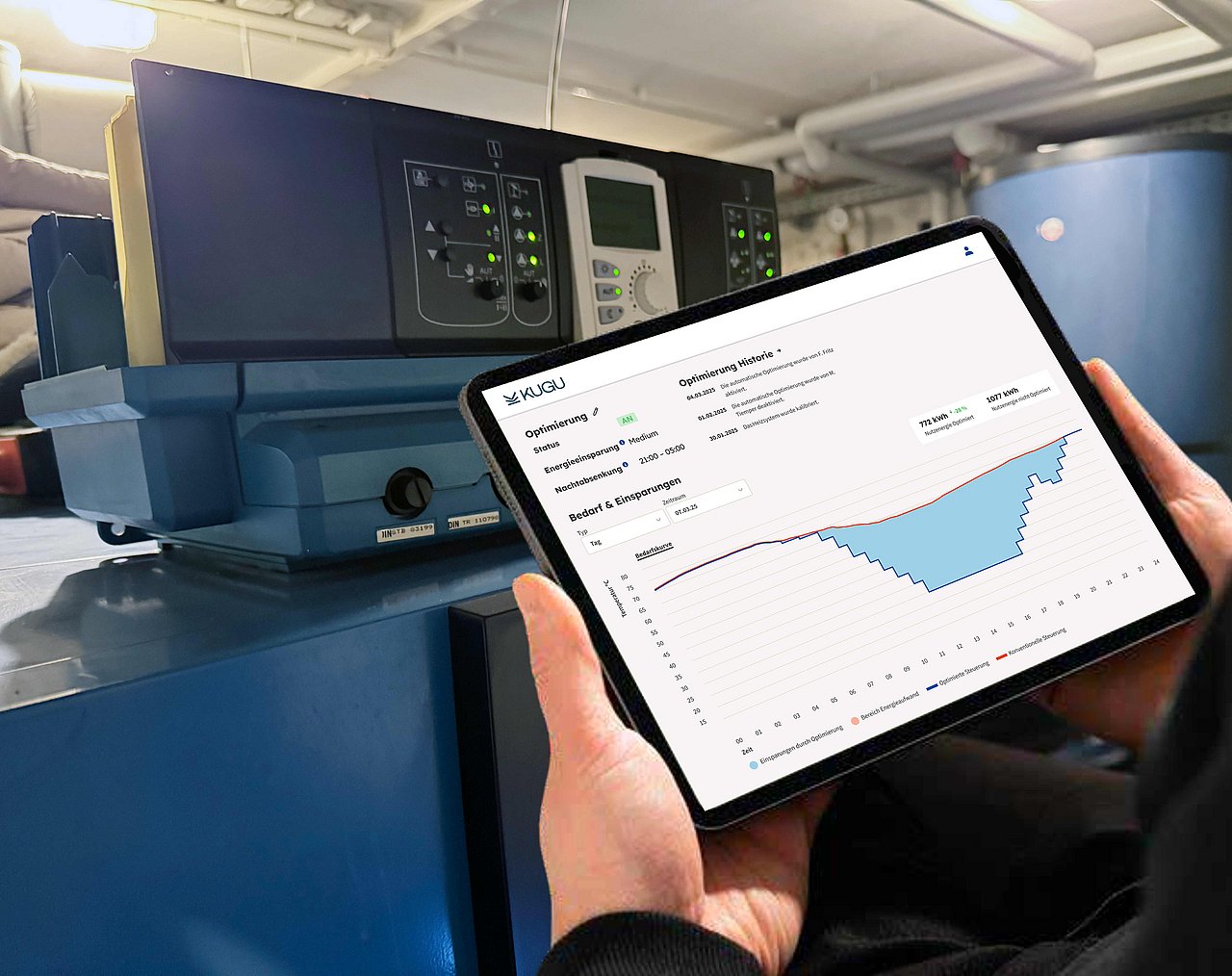
The provided online portal displays a live system diagram showing the current operating status, along with a corresponding energy dashboard.
- Calibration
After system activation, approximately three days of measurement data are required to calibrate the building using KUGU’s algorithms. This process is fully automated and requires no involvement from the customer. The software draws on various data sources to create the building’s individual Digital Twin of the energy system.
- Optimization
Each day, the system automatically receives an optimized predictive operating schedule for the next 24 hours –aligned with weather forecasts, building behavior, and usage patterns. In addition to outdoor temperature, solar radiation and wind conditions are also taken into account. Flow temperatures are adjusted at 15-minute intervals. If required, manual intervention and schedule adjustments can be made at any time via the online portal.
Results
Energy Savings
During the 2023/2024 heating season, KUGU reports energy savings of 27 percent. With a total consumption of 324,000 kWh, this corresponds to absolute savings of 87,480 kWh and approximately 20 metric tons of CO₂ equivalent.
Cost Benefits & Cost Allocation
In accordance with Section 7 (2) of the German Heating Costs Ordinance (Heizkostenverordnung), a measure of this kind could be fully allocated. With energy savings of at least 10 percent, tenants would also directly benefit from reduced heating costs.
Future-Proofing
According to KUGU, the building’s energy efficiency class improved by two levels as a result of the smart control system. The solution is compatible with Smart Meter Gateways and can be expanded at any time.
Challenges & Special Features
A key success factor was the Digital Twin, which enabled precise, predictive control of the heating system – aligned with the building’s real operational behavior and without manual intervention. Particularly in a mixed-use property (residential and commercial units), the effectiveness of data-driven control in practice became evident. Technical implementation was completed within a few hours during ongoing operations. As compatibility of the existing system had been verified in advance, no technical obstacles were expected. Integration was not only technically straightforward – it also demonstrates how low the barrier to entry for smart optimization in existing buildings can be.
Digitalization as a Lever
This project demonstrates that energy optimization is possible even without major structural modifications – provided the right levers are applied. Digitalization does not have to be expensive to be effective. For property owners, it offers a realistic and pragmatic solution: lower costs, assured comfort, and reduced emissions – without the need to completely reinvent the boiler room.
Here You can read the article.