Automated Billing: Making Heating and Operating Costs Digital

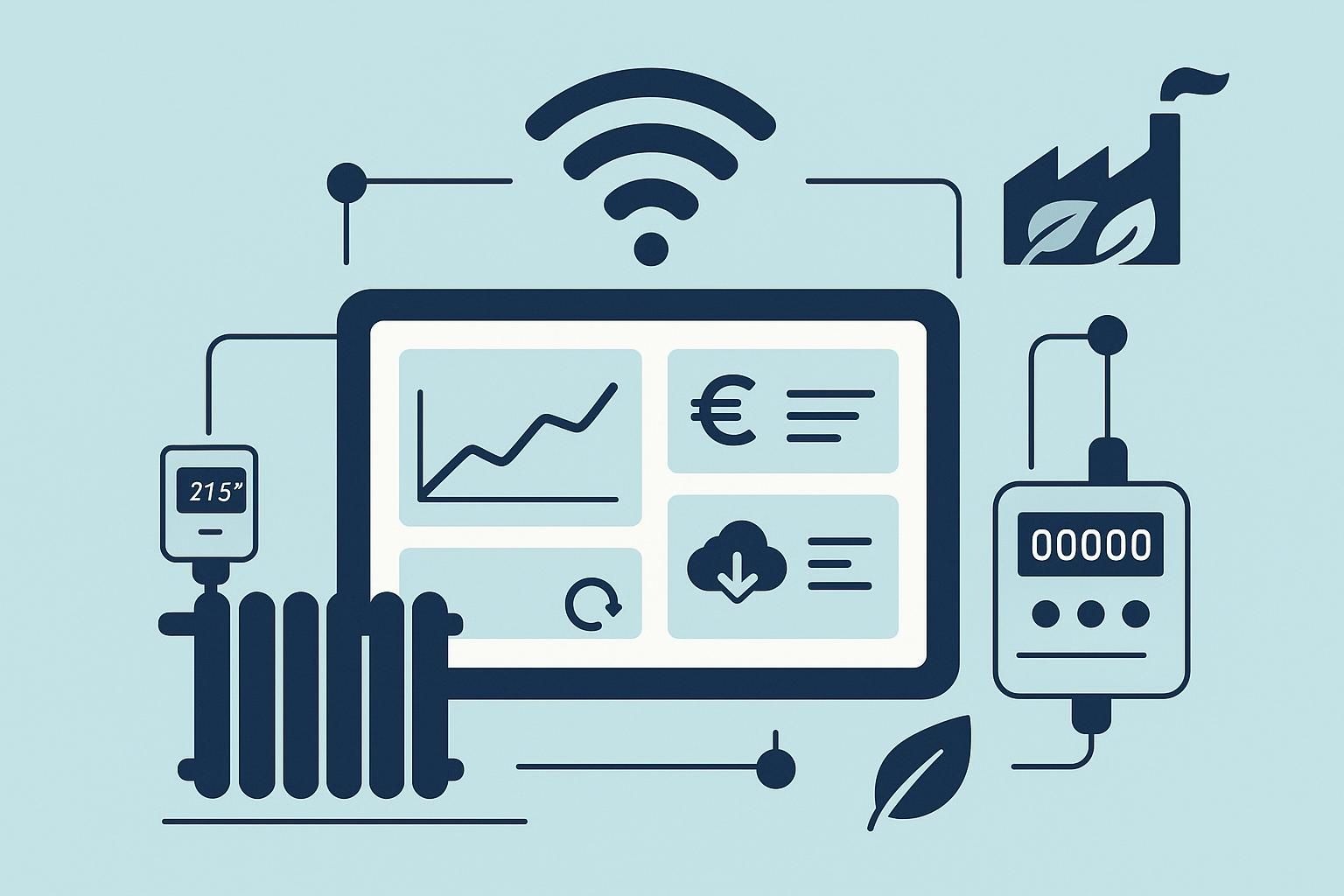
Automated billing means meter readings reach the system through remote reading, pass through automatic checks, and turn into the finished heating and operating cost statement without manual steps in between. For metering service providers and property managers, this shift increasingly decides how many residential units a team can still bill each year.
The pressure behind this is real: by the end of 2026, all existing meters that cannot be read remotely must be retrofitted or replaced, from 2027 monthly consumption information applies nationwide, and according to a current industry survey, more than six in ten property management companies already describe themselves as overloaded. Anyone still putting every statement together by hand right now is losing exactly the time that's missing for deadlines and growth.
Three figures show why switching now pays off for metering service providers, property managers and housing companies:
- According to the provider, KUGU AbSys already bills more than 500,000 residential and commercial units on an automated basis today.
- Without digital tools, billing 50 residential units typically takes one to two full working days.
- With end-to-end digital interfaces, the same billing run was completed within 24 hours in one documented real-world case.
- According to the 2026 VDIV Industry Barometer, 62.1% of property management companies already describe themselves as overloaded today.
What Does Automated Billing Actually Mean for Heating and Operating Costs?
Automated billing describes a process chain in which consumption data is no longer read and transferred by hand, but flows straight into the finished heating and operating cost statement through remote reading and automated interfaces. On the KUGU Messdienstplattform, this task is handled by AbSys, short for Abrechnungssystem, which according to the provider already bills more than 500,000 residential and commercial units automatically today.
Worth noting for context: automated billing sits within the KUGU Messdienstplattform. The KUGU Energieplattform covers heating optimization and operational transparency during day-to-day operation with EOS and VIS, while the Messdienstplattform bundles consumption capture, plausibility checks and statement creation with AbSys, Portal 2.0 and the associated middleware. Anyone who wants to know more about capturing the underlying data digitally will find details in our article on submetering software for digital consumption capture.
The time pressure behind this comes from the amended German Heating Costs Ordinance (HeizkostenV): every existing meter that cannot be read remotely must be retrofitted or replaced by 31 December 2026, monthly consumption information becomes mandatory nationwide from 2027, and devices that are already remotely readable but not yet interoperable may be retrofitted until the end of 2031. If remote readability or monthly information is missing, tenants and owners can claim a reduction right of up to 21% of heating costs for repeated violations. The core segment this applies to is large: Germany counted around 44 million residential units at the end of 2025, of which 23.6 million sit in roughly 3.5 million multi-family buildings.
How Does the Automated Workflow Run From Meter Reading to Billing?
The workflow breaks down into four phases. Today, the first three run largely on their own, and only the last one stays deliberately in human hands.
- Digital consumption capture: Remotely readable meters and smart-meter gateways send readings straight to the middleware, without anyone having to walk through the building or note values by hand.
- Data processing: The middleware matches incoming values to the right properties, units and billing periods, and reconciles the different formats used by various meter manufacturers.
- Plausibility checks and estimated values: The system automatically flags unusual readings, for example after a meter swap or an outage, and fills gaps with estimated values based on stored rules before the statement is generated.
- Statement creation, approval and special cases: The system produces the finished heating and operating cost statement, allocation keys included, while staff spot-check results, handle disputes and sign off on genuine exceptions.
This last step is exactly where people remain indispensable: whether a meter belongs to a vacant unit, an ownership change happened mid-billing-year, or there's an actual technical fault still needs someone with the right expertise to judge. Automation takes over the routine work; the call on real edge cases stays with the team in metering services or property management.
What Efficiency Gains Does Automated Billing Bring to Metering Service Providers and Property Managers?
The efficiency gain shows up first in turnaround time: without digital tools, billing a property with 50 residential units typically takes one to two full working days. With end-to-end digital interfaces between property management software and metering services, the same statement can be produced within 24 hours instead of the usual one to two days, as one documented case shows.
How much this affects staffing capacity across an entire operation is illustrated by a real-world case: housing company GSW Frankfurt reported around 10 to 20% more time capacity after introducing an integrated, automated billing setup, because its heat metering service could pull consumption data directly from the ERP system instead of receiving it manually. The German Association of Property Managers (VDIV) goes even further, putting the potential of intelligent ERP systems at more than 50% less staffing effort in property management. That figure, however, is an industry-association estimate without a disclosed methodology, and should be read as a directional signal rather than a reliable market average.
A look at the industry's staffing levels explains why this lever matters right now: in the 2026 VDIV Industry Barometer, 62.1% of surveyed property management companies said they were overloaded, with the figure climbing further at larger companies. That makes scalability the real argument for automation: a system that bills 500 units correctly handles 50,000 with the same logic, without capacity needing to grow in proportion.
Good to know: How high the actual error rate is in manual operating cost statements depends heavily on methodology. The German Tenants' Association (Deutscher Mieterbund) has estimated for years that roughly one in every two statements contains errors. A 2026 Mineko analysis puts the figure as high as 86%, though that's based on a self-submitted, pre-selected sample of disputed statements, in other words exactly the cases tenants bothered to have checked in the first place. Neither number is a market average, but regardless of methodology, both point the same way: manual matching and data entry rank among the biggest sources of error, and automated plausibility checks reduce that structurally.
What Interfaces and Data Quality Does Automated Heating Cost Billing Need?
Automated billing is only as good as the interfaces behind it: between metering technology and property management software, every data point needs to travel through the middleware without a media break, otherwise you end up with exactly the manual rework automation is supposed to eliminate. KUGU describes how the Messdienstplattform solves this technically on its own Submetering Suite system overview: AbSys connects to property management software such as Aareon and SAP as well as DATEV and casavi, each through open interfaces, and uses the ARGE/BVED data exchange standard in versions 2.1 through 3.10 for provider switches.
On the metering technology side, a second critical issue emerges: mixed meter inventories. In most existing portfolios, older, mechanically read meters sit alongside remotely readable devices from different manufacturers. A manufacturer-independent middleware like AbSys's connects with metering technology from providers such as Engelmann or QUNDIS as well as smart-meter gateways and LoRaWAN networks, so a mixed inventory doesn't turn into partly manual billing. How far this transition has already progressed shows in a VDIV survey of more than 300 property management companies: roughly two years before the deadline, 58% of homeowner associations and 61% of rental properties already had remotely readable metering technology installed.
Data quality is more than a technical footnote here. Incorrect master data, such as mismatched living space figures or allocation keys, carries over unchecked with every automation run and compounds across thousands of units. Before switching over, it's worth reconciling the master data in the property management software against the actual meter landscape.
What Does Introducing an Automated Billing Solution Cost, and When Does It Pay Off?
With established systems, rollout follows a fixed, predictable path. For AbSys, that means four steps: an inventory of the existing meter and software landscape, an interface check against the current property management software, a data migration with a test run on real portfolios, and finally the rollout with training during ongoing operations. Our article on rolling out digital systems in existing buildings covers the concrete steps of a system introduction, and its approach translates structurally to a billing rollout as well.
On cost, it's worth being transparent about what the market actually offers: for small landlords with only a few units, self-service SaaS tools charge tiered monthly fees starting around €10 to €40 depending on unit count, and at least one provider bundles the entire chain, from devices and remote reading through to the finished statement, into a full-service flat fee of €150 per residential unit per year. An independent, publicly available price list for enterprise licensing, the kind metering service providers and housing companies with thousands of units need, doesn't exist yet. Those prices are negotiated directly with the provider and depend mainly on unit count and interface depth.
On price transparency: Unlike private landlord portals, there's no public comparison list for enterprise billing software in the metering services and housing sector. Anyone collecting multiple quotes should therefore ask specifically about the price per unit per year and the cost of interfaces to the existing property management software.
When the switch pays off depends less on the purchase price than on the working time saved. With savings of one to two working days per 50 residential units per billing run, an automation solution often pays for itself within a single billing season for medium and larger portfolios, because the same staff can take on additional properties without new positions having to be created. Our comparison of heating cost billing providers breaks down exactly how classic metering service providers, digital platform providers and property management software with a billing module differ.
What Role Will Artificial Intelligence Play in Automated Billing From 2026?
So far, billing software mostly automates rule-based steps: reading in values, checking them against fixed thresholds, generating estimated values from a stored formula. The next stage is AI agents that also take on the cases that currently sit and wait for a case handler. At the KUGU user conference in June 2026, KUGU introduced a new middleware layer that connects AbSys more closely with Portal 2.0, the data pipeline and external interfaces, and announced AI agents for billing processes for the following months.
In practice, that means an AI agent will be able to work out on its own whether a discrepancy stems from a meter swap, a change of occupant, or genuinely faulty data, and deliver a resolution proposal that a human only needs to confirm. For metering service providers under staffing pressure, that pushes the automation boundary further into exactly the special cases that have caused the most manual effort until now.
Automated Billing Is Becoming Core Infrastructure for Metering Services
The real takeaway from the HeizkostenV deadlines, the staffing shortages and the first real-world evidence: by 2027, automated billing will shift from a differentiator a few frontrunners use to a baseline the law effectively assumes. Anyone who only switches over shortly before the deadline for monthly consumption information ends up digitizing under time pressure, with a data foundation that's rarely clean enough for a smooth rollout.
For metering service providers, property managers and housing companies, that means: the earlier the interfaces to metering technology and property management software are properly in place, the sooner the coming monthly consumption information can be generated from existing data rather than a brand-new project. The first sensible step is usually an honest inventory of your own meter and interface landscape, before any decision on a new system gets made.
Frequently Asked Questions About Automated Billing
How long does the switch from manual to automated billing take?
According to provider information, an introduction like the one for AbSys runs through four fixed steps, from inventory to rollout, usually over several weeks to a few months, depending on the number of properties and the quality of existing meter and master data. A prior interface check noticeably shortens the testing phase.
What happens with automated billing if individual meters can't be read remotely?
Meters that can't be read remotely are still captured on site, with the values entered manually afterward until the devices are upgraded. By the end of 2026, all existing meters that aren't remotely readable must be replaced or retrofitted anyway, after which this special case largely disappears.
Can tenants still file a dispute with automated billing?
Yes, the right to dispute a statement remains in place regardless of how the statement was created. Automated systems document meter readings and calculation steps in full, which in practice tends to speed up how a property manager or metering service can review a dispute, not slow it down.
Is automated billing worth it for smaller portfolios under 50 residential units?
Yes, smaller portfolios benefit too, though the investment pays for itself more slowly than it does for large portfolios. For very small portfolios, cheaper self-service SaaS solutions with tiered monthly pricing starting around €10 to €40 are often the more economical choice, while enterprise solutions show their real strength only from several hundred units upward.
How does the HeizkostenV reduction right affect automated billing systems?
If remote readability or monthly consumption information is missing, tenants and owners can claim a reduction right of up to 21% of heating costs for repeated violations. Automated systems lower this risk because they secure remote reading and monthly information technically from the start.