Heating System Assessment: Costs, Process and When You Actually Need One

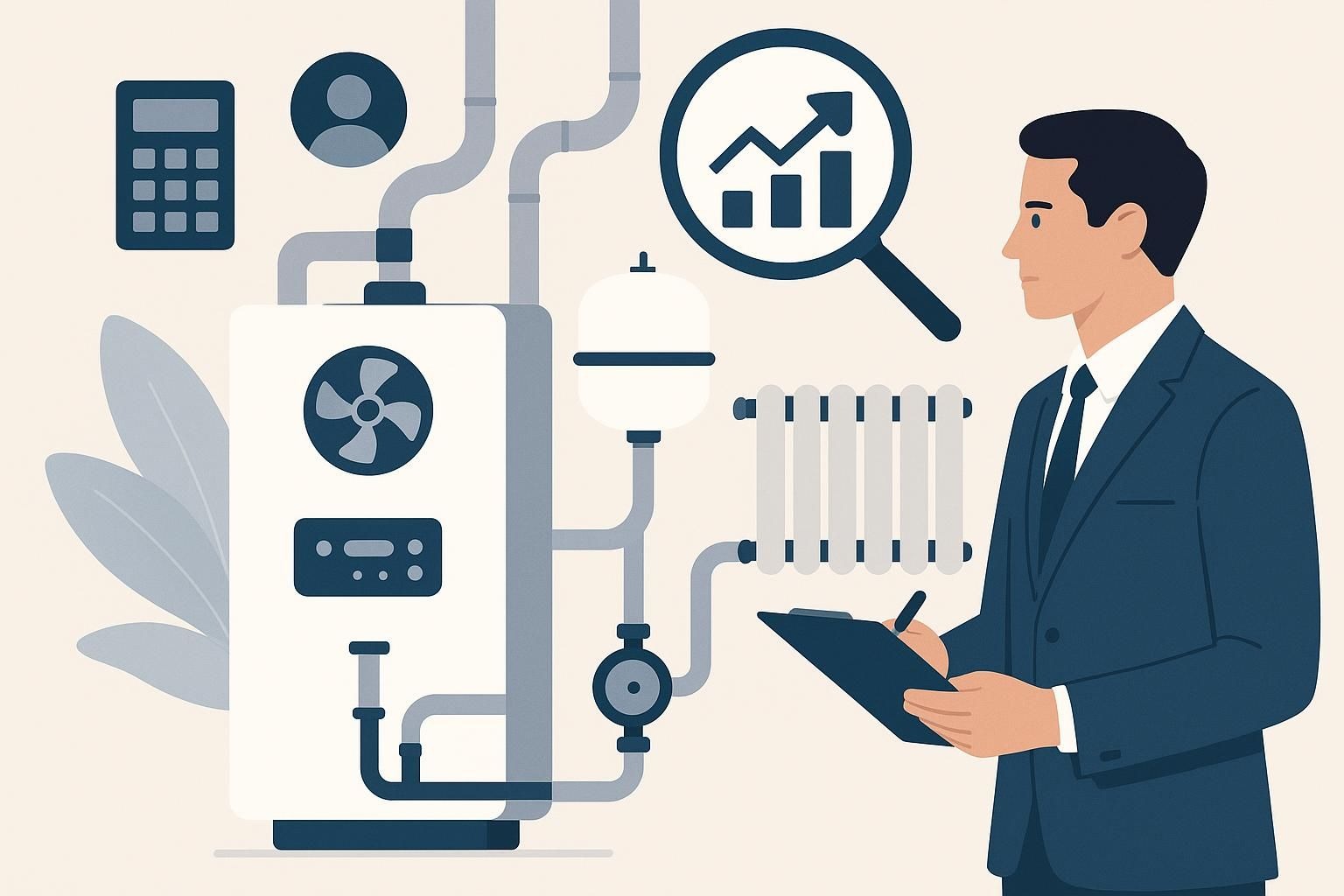
A heating system assessment gives an independent, expert view of technical defects, efficiency losses and the economic damage a system may be causing. Surveyors typically charge €500 to €2,000 for a single-family home, while assessments of complex systems in multi-family buildings usually start at €1,500. From six residential units upward, a statutory inspection obligation applies on top of that.
For technical managers responsible for existing building stock, the trigger is usually a concrete problem: a system that keeps failing despite regular servicing, consumption figures that make no sense, or an upcoming refurbishment where the starting point needs to be documented properly. An assessment provides exactly that: an independent, defensible read on the technical condition of a system.
In practice, four situations most often decide whether the effort is worth it:
- Recurring faults or breakdowns often point to a missing hydraulic balance or an incorrectly configured control system.
- A noticeable drop in efficiency with no obvious cause justifies an independent technical evaluation of the system.
- Ahead of a refurbishment or heating system replacement, the assessment documents the current condition as a decision basis.
- In disputes with contractors or insurers, an expert report provides a legally usable foundation.
When a heating system assessment is really necessary
A heating system assessment pays off above all when there is uncertainty about a system's installation, performance or economic consequences. A practising heating and sanitary engineering surveyor names disputes, looming follow-up costs and an approaching end of the warranty period as typical reasons for commissioning one.
- Recurring faults: A system that keeps failing despite repeated servicing needs an independent fault diagnosis rather than another routine service visit.
- Efficiency loss: Rising consumption without any structural change is a clear signal to check the entire system technically.
- Before refurbishment or replacement: The current condition of the boiler, hydraulics and distribution helps determine which investment is actually worthwhile.
- Disputes: Conflicts with contractors, insurers or previous owners call for an independent finding that holds up in court.
- Condition and value assessment: When buying or selling an existing building, the report reveals the real technical value of the heating system.
It's worth keeping the roles separate here: a surveyor is the right contact for technical defects, damage or contractual deviations, while an energy consultant handles funding questions, refurbishment roadmaps or proof of compliance with the GEG (Germany's Buildings Energy Act). Mixing the two rarely produces either a solid defect report or a fundable refurbishment roadmap.
What a surveyor actually checks on the boiler, hydraulics and controls
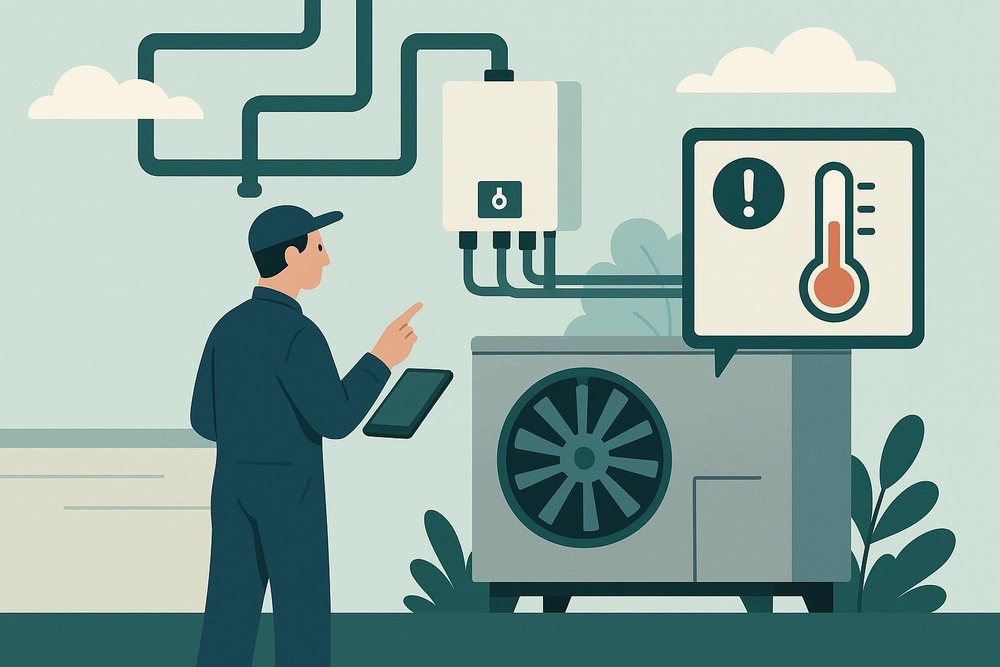
Every assessment centres on the heat generator itself, the hydraulics, the controls, the pipe insulation and how well the entire system is sized for the building. The surveyor checks whether the boiler or heat pump matches the actual heat load, whether distribution across the building is balanced, and whether the controls run the system economically.
In day-to-day assessment work, the same fault patterns keep coming up. A heating surveyor portal lists four defects that appear especially often in reports:
- Missing hydraulic balancing: water flows preferentially to nearby radiators, leaving rooms further away underserved.
- Incorrectly sized components: oversized heat generators or poorly matched radiators cycle more often and use more energy.
- Wrongly set heating curve: the controls run flow temperatures that are simply too high for the building.
- Poorly placed outdoor sensor: sun, wind or nearby heat sources distort the control signals for the whole system.
Good to know: Two figures show how widespread such defects are, though they refer to different scopes. According to an industry guide from the VdZ, more than 80 percent of all heating systems in Germany are not optimally hydraulically balanced, with a savings potential of up to €1.5 billion and 5.3 million tonnes of CO₂ per year. A widely cited industry analysis puts the share of insufficiently efficient central heat generators nationwide even higher, at 71 percent, though the exact survey year could not be clearly established from the secondary source. Both figures point to the same underlying reality from different angles: most existing systems run less efficiently than they could.
The cost of fixing this defect gives a sense of the scale involved: for a building with five residential units, Germany's consumer advice centre (Verbraucherzentrale) puts the cost of hydraulic balancing at around €5,000, while a specialist firm typically needs about six to seven hours to complete the job in a single-family home.
What does a heating system report cost, and who prepares it?
A basic findings report for a single- or two-family home typically costs €500 to €1,000, while a detailed report with a full evaluation runs €750 to €2,000. For complex systems in multi-family buildings, cascaded setups or properties with many residential units, a certified surveyor puts starting costs at around €1,500, rising well beyond that depending on the scope of the inspection.
| Service | Typical Costs |
|---|---|
| Findings report (single/two-family home) | €500 – €1,000 |
| Detailed report (single/two-family home) | €750 – €2,000 |
| Surveyor hourly rate | €75 – €200 / hour |
| Complex system / multi-family building | from approx. €1,500 upward |
| Refurbishment roadmap (iSFP) by an energy consultant | €1,300 – €2,000, BAFA funding up to €850 |
These ranges are guide values, not binding quotes. As a heating and sanitary surveyor specialising in heat pump and heating system reports explains, preparation typically takes 7 to 14 working days from the on-site visit and complete receipt of documentation, longer for more complex cases. To reach a reliable result, the surveyor usually needs the following documents:
- Quotes and invoices from the system's original installation
- Sizing and component lists, plus the hydraulic schematic
- An existing heat load calculation for the building
- Commissioning and service records from recent years
- Current consumption figures and clear photos of the system
Reports are prepared by publicly appointed and sworn surveyors, or by surveyors certified under DGuSV or ISO 17024, who produce reports for private clients, courts or insurers. Once the question shifts from defects to funding, GEG compliance proof or an individual refurbishment roadmap, an energy consultant is the more suitable contact, with services typically costing €1,300 to €2,000 and partially funded by BAFA.
When a heating inspection becomes mandatory under the GEG and GModG
Central, water-based heating systems in buildings with at least six residential or usage units are subject to a statutory obligation for heating inspection and optimisation. This obligation originally sat in §60b of the GEG and has been carried forward unchanged in substance under the Building Modernisation Act (GModG) since 29 July 2026, now supplemented by a hydraulic balancing requirement for new installations under §60c.
Keep the deadline in view: for heating systems installed before 1 October 2009, the deadline for inspection and optimisation runs until 30 September 2027. Anyone operating such systems in their existing portfolio shouldn't leave the proof of inspection to the last quarter of 2027.
Larger housing companies without their own energy management system may face additional obligations: non-SMEs with 250 or more employees, or annual revenue above €50 million, must have an energy audit carried out under DIN EN 16247 every four years under the Energy Services Act, with fines of up to €50,000 per site for non-compliance. This audit obligation doesn't replace the heating system report, but it does add a portfolio-level layer of condition assessment.
Why a one-off assessment only ever captures a snapshot
A report documents a system's condition on a given day, under the conditions that happen to apply that day. Many operating faults and efficiency losses, though, only become visible over weeks and across seasons: a heating curve that looks unremarkable in spring but drives flow temperatures too high in winter, or control behaviour that only proves inefficient once usage patterns vary across several apartments.
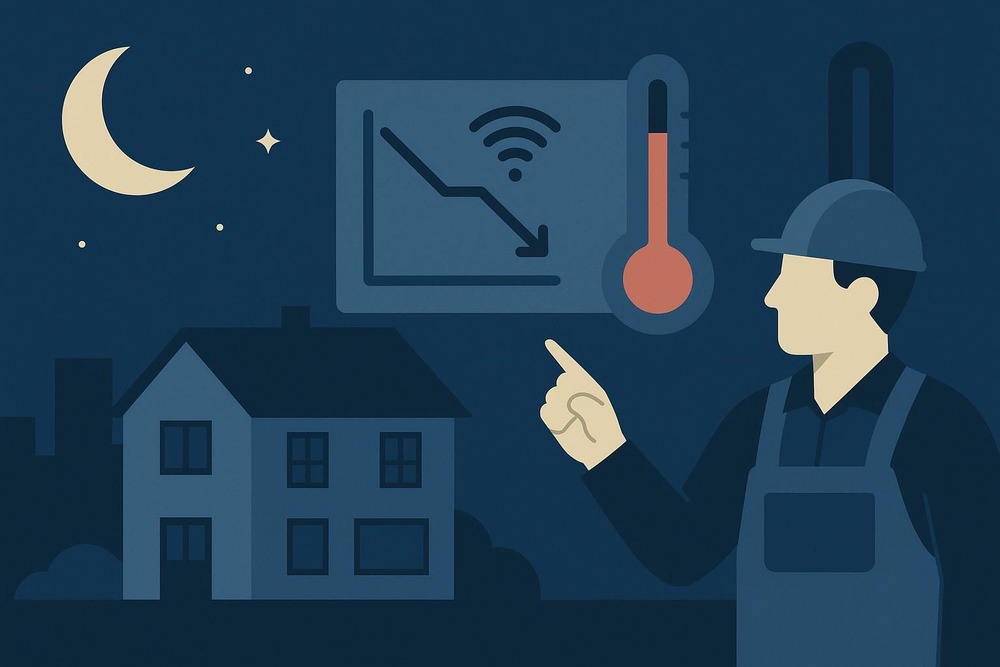
For existing portfolios, that means a report reliably answers the question of condition at the time of inspection, but not how the system actually behaves in the months that follow. This is precisely the gap that continuous system diagnostics addresses, catching operational faults as they occur rather than waiting for the next assessment.
How KUGU VIS Anlagendiagnose complements the report during ongoing operation
Continuous heating monitoring complements a one-off report by catching faults early and keeping optimisation potential permanently visible, rather than documenting it only on a single inspection day. For operators of larger portfolios, that's more than a matter of convenience: it changes how reliable technical oversight of a system can actually be.
Good to know: according to an official dossier from the dena competence centre KEDi, the statutory requirements under §60a and §60b of the GEG/GModG can also be met through a digital monitoring system, provided it continuously monitors and logs system operation and automatically detects efficiency losses. That means the inspection obligation can be proven not just once, but on an ongoing basis.
This is exactly where KUGU VIS Anlagendiagnose comes in: it evaluates a heating system's condition against more than 20 criteria, including hardware condition, operating behaviour, hydraulics and efficiency, and derives concrete recommendations for technical improvements. VIS stands for Visuelles-Informationssystem (visual information system), the platform KUGU uses to make energy data and system condition visible across buildings and portfolios. For a closer look at which operating faults tend to cost portfolios the most money, see Anlagendiagnose Heizung: Welche Fehler Bestände Geld kosten.
For technical managers, this translates into a practical division of labour: a classic assessment remains the right route for disputes, purchase or valuation questions, and acute damage. For ongoing operational reliability and the statutory proof obligation over the years that follow, continuous system diagnostics carries considerably further. For a closer look at how the potential it uncovers can then be captured, see Heizungsoptimierung im Bestand: Hebel, Kosten, Einsparpotenzial.
From inspection report to lasting operational transparency
An assessment and continuous system diagnostics answer different questions about the same system. The report delivers an independent, legally defensible finding for a specific point in time, while ongoing diagnostics shows whether the system still performs as it should in October, in February, and as occupancy patterns shift.
For existing portfolios subject to the inspection obligation under §60b of the GModG, a two-step approach pays off: a report or initial inspection as a solid starting point, followed by a monitoring system that maintains proof of compliance for the entire remaining period. As a concrete next step, it's worth reviewing your existing portfolio against the 30 September 2027 deadline and checking whether digital system diagnostics can cover the upcoming proof obligation at the same time.
Frequently asked questions about heating system assessments
Can digital monitoring replace the legally required heating system report?
Yes, for the ongoing inspection and optimisation obligation under §60a and §60b of the GEG/GModG, a digital monitoring system is sufficient, provided it continuously monitors and logs operation and automatically detects efficiency losses. For disputes, damage or pre-purchase checks, however, a classic expert report remains the right approach.
How does the cost of an energy consultation compare to a heating system report?
An individual refurbishment roadmap from an energy consultant typically costs €1,300 to €2,000, of which BAFA funds half, up to a maximum of €650 for single- or two-family homes and €850 for residential buildings with three or more units. A pure defect assessment from a surveyor falls in a similar range, at €500 to €2,000, but covers different questions.
Do I need a separate report before replacing a heating system?
No, a standalone report is unusual before a heating system replacement. In practice, the starting point is normally established through a heat load calculation or an energy consultation with an individual refurbishment roadmap; a report tends to come into play only where defects already exist or a dispute is underway.
How long does a heating system report take, from commissioning to the finished document?
From the on-site visit and complete receipt of all documents, preparation typically takes 7 to 14 working days. For complex systems, such as larger multi-family buildings with several heat generators, this timeframe can stretch out noticeably.
From what system size does continuous diagnostics make more sense than a one-off report?
The more residential units and the more complex the system technology, the more the benefit tips toward continuous diagnostics over a one-off report. At the latest once a portfolio crosses the statutory inspection threshold of six residential units, the comparison is worth making, since ongoing proof of system optimisation is required there anyway.