M-Bus Explained: How Meter Data Reaches Your Billing System

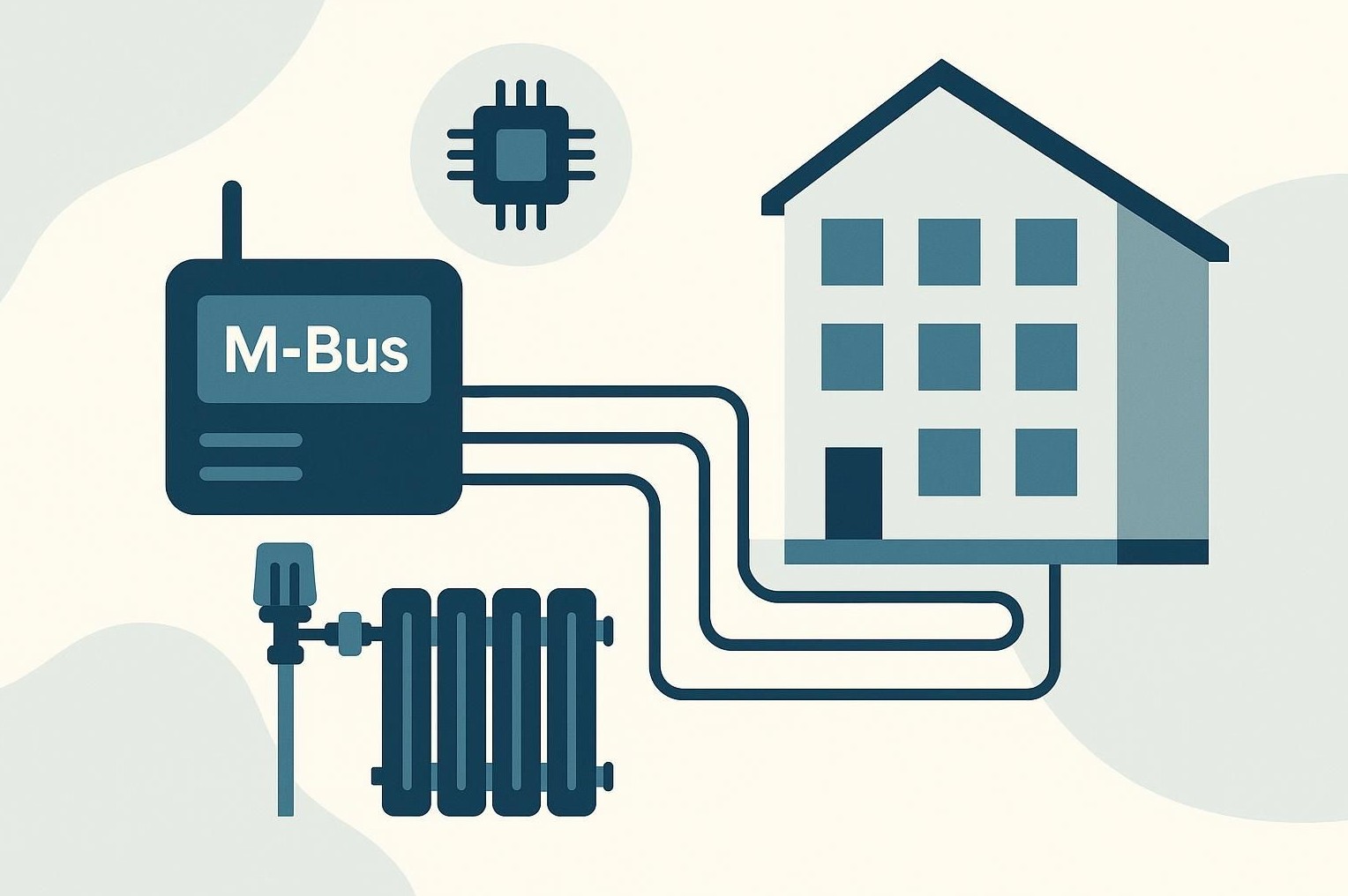
M-Bus (Meter-Bus) is a European fieldbus standard under EN 13757 that lets heat, water, gas and electricity meters send their readings serially to a central master. A master polls every connected meter individually over a polarity-protected two-wire line and reads out the consumption data automatically. For building operators, that is the technical foundation of any remotely readable metering infrastructure.
For technical managers, IT leads and metering service providers, M-Bus is therefore far more than an electronics detail. It is the interface where meter data actually becomes digitally usable in the first place. Whether that data arrives cleanly in billing and monitoring systems comes down to the choice between cable and radio, the devices selected, and the quality of the middleware behind them.
Anyone converting an existing portfolio to remote reading has to keep several technical and regulatory points in view at once:
- Wired M-Bus and Wireless M-Bus belong to the same standards family, but they differ significantly in range and installation effort.
- An M-Bus segment supports up to 250 meters under primary addressing; larger installations need repeaters or secondary addressing.
- Under Germany's Heizkostenverordnung, existing heat meters and heat cost allocators must be retrofitted for remote reading by December 31, 2026.
- Gateways and middleware determine whether consumption data lands correctly in billing and monitoring systems.
How does an M-Bus master actually read meter data?
An M-Bus master polls every connected meter, known in the field as a slave, serially and one at a time over a shared two-wire line. That line is wired to prevent polarity errors and also powers the slaves at the same time, so the meters themselves need no battery or separate power connection. The process is standardized in EN 13757-2 for the physical transmission layer and EN 13757-3 for the application layer, which defines how heat, water, gas and electricity meters encode their readings.
Data rates range from 300 to 9,600 baud depending on the installation, with 2,400 baud established as the practical standard. Each meter only responds when the master addresses it directly, which is why the bus stays conflict-free even with many devices connected.
How many meters fit on one M-Bus line?
A segment supports a maximum of 250 meters under primary addressing, with an address range from 1 to 250. Larger properties cascade several segments using repeaters, and secondary addressing via the serial number lets you address considerably more meters uniquely than primary addressing alone allows. Physically, a wired M-Bus line with good cable quality can reach up to 10 kilometers. In real building practice, though, the usable distance comes in well below that technical ceiling, limited by cable cross-section, the chosen baud rate and the number of meters connected.
Wired M-Bus or Wireless M-Bus: which variant fits the building?
Wired M-Bus sends meter data over a fixed two-wire line, while Wireless M-Bus (wM-Bus) does the same job over radio and is specified as its own part of the standards family in EN 13757-4. In Europe, wM-Bus mainly uses the license-free 868 MHz band, with 433 MHz and 169 MHz used to a lesser extent. The operating modes, among them S-, T-, C- and N-Mode, differ in range, data rate and the power consumption of the radio modules. N-Mode at 169 MHz suits difficult installation spots such as basements and shafts particularly well, because it trades data rate for greater range.
In everyday building operation, realistic wM-Bus range typically sits between 20 and 100 meters, depending on the walls, ceilings and shafts between meter and receiver. Figures of several hundred meters up to a kilometer, as some hardware manufacturers quote for open, unobstructed areas, are the exception in residential buildings and not a realistic basis for planning.
Read range figures with context: Manufacturer specifications for wM-Bus range often come from open-field measurements with no walls or ceilings in between. For planning in existing buildings, what matters is the practical value inside an occupied building, not the technical best case under lab conditions.
| Criterion | Wired M-Bus | Wireless M-Bus (wM-Bus) |
|---|---|---|
| Standard | EN 13757-2/-3 | EN 13757-4 |
| Transmission | Two-wire line, master polls serially | Radio, typically 868 MHz |
| Range | Up to 10 km cable length (technical ceiling) | Practical value 20 to 100 m in residential buildings |
| Installation effort | Cable run to the meter required | No cable, but radio planning needed per location |
| Typical use | New builds, central meter rooms, retrofits with existing wiring | Existing buildings without wiring, distributed meter locations, retrofits during ongoing occupancy |
In practice, the existing building condition usually decides the choice. If a meter line already exists or can be run with reasonable effort, wired M-Bus stays the more robust, lower-maintenance option. If wiring is missing or meters sit scattered across individual apartments, wM-Bus saves exactly the wall-breaking work that would otherwise slow down a retrofit in occupied buildings.
Which meters speak M-Bus, and how does the data reach the billing system?
M-Bus works with essentially all common consumption meters found in a building, including heat meters, water meters, electricity meters and gas meters, as well as heat cost allocators and supplementary sensors. So that devices from different manufacturers work reliably together on the same network, the Open Metering System (OMS) has become established on top of M-Bus. It is the only Europe-wide system definition that brings electricity, gas, heat and water, including submetering, together under one manufacturer-independent standard.
What OMS certification means in practice: OMS-compliant devices are certified by the independent body DVGW CERT or VDE. For operators, that means a heat meter from Manufacturer A and a water meter from Manufacturer B can run on the same M-Bus network without readout failing due to incompatibility.
A gateway typically sits between the meter and the billing process. It receives the M-Bus or wM-Bus telegrams, checks and decrypts them where needed, and forwards the readings to a backend over IP protocols. In regulated smart-meter infrastructures, this handover can additionally run through a separate smart-meter gateway. Only the middleware behind it turns raw telegrams into usable consumption data for billing and monitoring, for example on the KUGU Messdienstplattform, where AbSys, KUGU's Abrechnungssystem, processes exactly this M-Bus data for heating and operating cost statements. How this chain works in detail, from meter data capture through to the finished statement, is covered in the article on submetering software for digital consumption capture.
Why is remote reading via M-Bus now becoming mandatory?
Germany's Heizkostenverordnung has turned remote readability into a legal requirement: since December 1, 2021, newly installed heat meters, heat cost allocators and hot water meters must be remotely readable, and since December 1, 2022, they must also be interoperable and smart-meter-gateway capable. The basis for this is the EU Energy Efficiency Directive 2018/2002. For existing devices that don't yet meet this requirement, Section 5 HeizkostenV sets a retrofit deadline of December 31, 2026, a date Germany deliberately moved up from the actual EU deadline of January 1, 2027.
Once devices are remotely readable, Section 6a HeizkostenV has additionally required monthly consumption information for users since January 1, 2022, comparing usage to the previous month, the same month a year earlier, and an average user. This is exactly where M-Bus reading in the background decides whether this mandatory monthly information can be generated automatically and reliably at all.
Right to reduce payments for non-compliance: Under Section 12 HeizkostenV, tenants may reduce their cost statement: 15% if consumption-based billing is missing entirely, plus 3% each for missing remotely readable equipment and for missing or incomplete monthly consumption information. Under the prevailing interpretation, the two 3% reductions can be combined.
An industry association survey shows just how urgent this shift is: as of early 2025, according to that survey, around 40% of residential units in Germany still hadn't switched to remotely readable metering technology, with respondents citing limited installation capacity among metering service providers as the biggest obstacle. That snapshot predates the now fast-approaching end-of-2026 deadline and should be read as the state of one particular survey, not as the most current market figure.
Which error sources slow down M-Bus networks in daily building operation?
The most common faults in M-Bus networks rarely originate at the meter itself; they come from configuration and wiring. Four causes show up particularly often in practice:
- Address collisions: Two meters accidentally share the same primary address and block each other during readout.
- Interval-baud rate mismatch: The reading interval is set too tight for the chosen baud rate, cutting telegrams short.
- Wiring and shielding: Incorrectly run or unshielded cables generate interference that distorts the data transmission.
- Voltage drop: Excessive cable lengths let the voltage at the furthest slave fall below the minimum operating voltage required.
A practical rule of thumb: At 2,400 baud, plan for roughly 3 seconds to read out one meter. The slave needs at least 24 volts DC arriving at its terminals, otherwise it won't respond reliably.
A second, often overlooked error source doesn't lie in the field at all but in the software. M-Bus telegrams are self-describing and transmit unit, medium and scaling alongside the reading itself. If the downstream system doesn't interpret this information generically and instead expects fixed data structures, seemingly incorrect readings appear even though the meter measured correctly. Anyone looking to track down faults systematically rather than randomly in the digital boiler room will find deeper practical examples in the article on data-driven operations in the boiler room. Typical causes and a systematic troubleshooting approach are also summarized in a practical report from EMU Metering.
Why is standardized reading the foundation for portfolio automation?
Standardized M-Bus and OMS reading is what makes consumption data comparable across buildings, meter manufacturers and installation years in the first place. Without this standardization, every device would need to be interpreted individually, which effectively blocks automation at portfolio scale. With uniformly structured telegrams, by contrast, thousands of meters across different properties can be read out, validated and processed with the same middleware.
For day-to-day operations, that pays off twice over. Billing becomes more predictable, because consumption data arrives regularly and at consistent quality, and operations gain a data foundation that surfaces anomalies such as sudden consumption spikes early. The article on heating monitoring in multi-family buildings shows how remotely readable M-Bus data can be turned into concrete alerts and operational transparency across entire properties.
M-Bus as the foundation, not the final step of digitalization
The real point of the HeizkostenV deadline isn't the date itself, it's the capacity gap behind it. The technology has been mature and fully described in standards for decades, yet according to the industry survey, the nationwide rollout of hardware installation remains the actual bottleneck. Anyone still relying on existing meters without remote reading is only pushing the problem to a moment when installation capacity across the market will be even tighter.
For portfolios, it's therefore worth looking beyond mere compliance. M-Bus and OMS don't just deliver the remotely readable values that Sections 5 and 6a HeizkostenV require, they provide the data foundation that makes billing, monitoring and operational optimization automatable in the first place. Anyone planning the conversion anyway should not treat the gateway and middleware choice in isolation from the question of how that data will later feed into billing and monitoring processes.
Frequently asked questions about M-Bus
Is M-Bus the same thing as a smart-meter gateway?
No, M-Bus is the fieldbus standard that meters use to send their readings to a master, while a smart-meter gateway is a separate, additional component. In regulated infrastructures, it handles the secure handover of already-read data to authorized market participants. The two systems complement each other but don't replace one another.
Can meters from different manufacturers run on the same M-Bus line?
Yes, as long as the devices comply with the Open Metering System and are certified accordingly. OMS was deliberately designed as a manufacturer-independent standard, so heat, water, electricity and gas meters from different vendors can work together on the same network. DVGW CERT certification serves as the practical proof of that interoperability.
How many meters can be connected to one M-Bus line before a repeater is needed?
Up to 250 meters are possible per segment under primary addressing, after which a repeater is needed for cascading. Secondary addressing via the serial number lets you address additional meters uniquely without exhausting the 1 to 250 address range. In practice, the actual limit also depends on cable length and power supply.
What happens if an existing meter isn't converted to remote reading by the end of 2026?
Tenants can then invoke reduction rights under Section 12 HeizkostenV, cutting the cost statement by up to several percent. On top of that, the monthly consumption information required under Section 6a HeizkostenV remains practically impossible to automate without remotely readable technology. The law only allows exceptions where remote reading is technically impossible or disproportionately costly.
Why does an M-Bus meter sometimes report seemingly incorrect readings?
In most cases, the cause isn't the meter but the software evaluating its data. M-Bus telegrams transmit the reading, unit, medium and scaling in a self-describing format, and if a system doesn't interpret that information generically, faulty displays appear despite an accurate measurement. Checking the master configuration resolves these cases more often than swapping out the meter.