Heat Meters for Heating Systems: Function, Legal Requirements, Installation

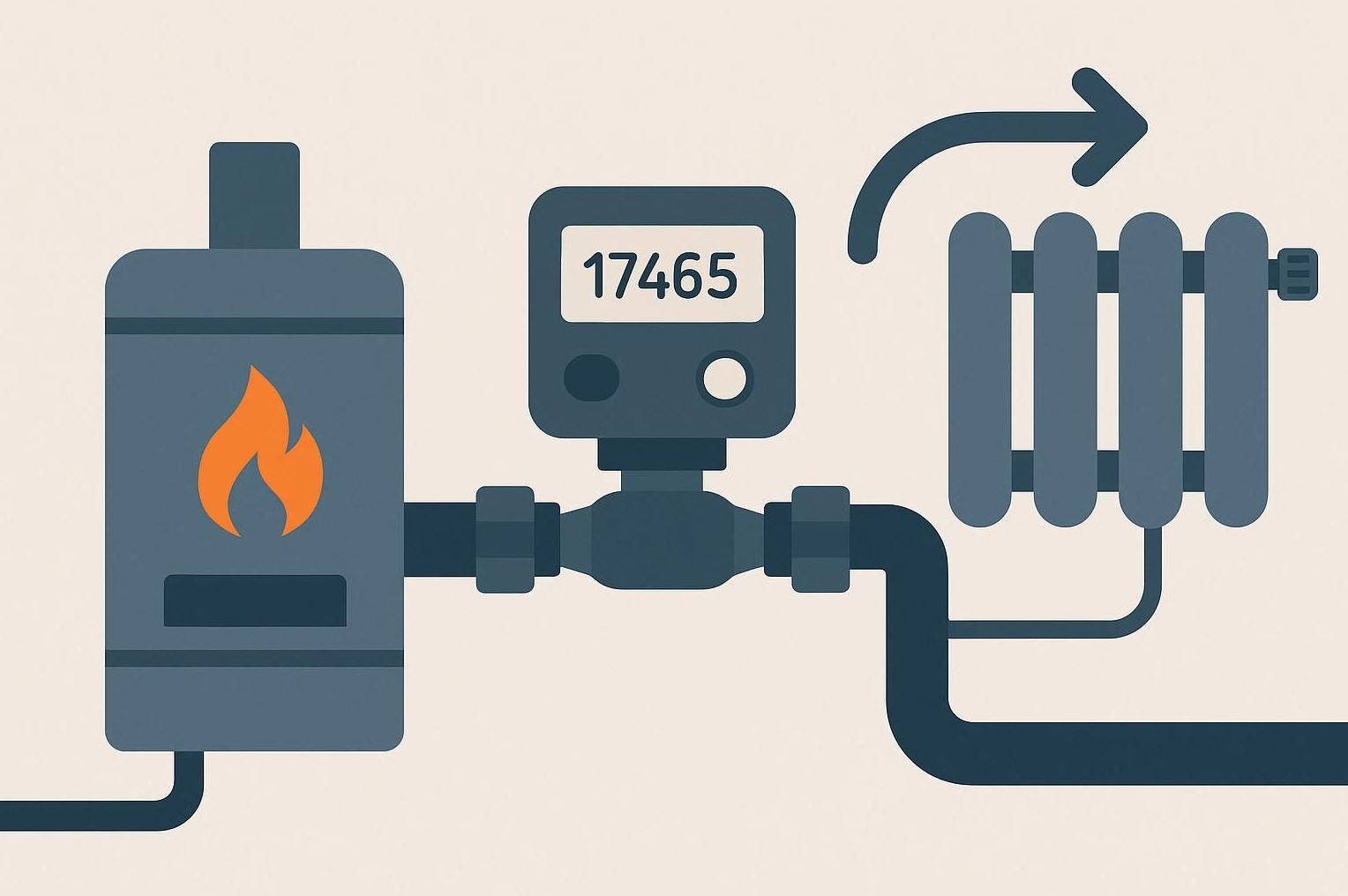
A heat meter on a heating system measures how much heat a heating circuit or an apartment actually consumes, converting flow rate and the temperature difference between supply and return into a single value in kilowatt-hours. It is precisely this physically measured value that determines how heating costs are apportioned and whether a property meets the requirements of Germany's Heating Costs Ordinance (Heizkostenverordnung). For housing companies, property managers and metering service providers, it is therefore far more than just a line item on the bill.
Unlike a heat cost allocator, a heat meter delivers a calibrated measurement rather than a mere ratio figure. That makes it the decisive building block for compliant billing, especially where hot water is generated centrally and in buildings heated by heat pumps. Choosing the right devices and reading their data properly also delivers a data foundation that reaches far beyond cost allocation alone.
Between the list of legal obligations and everyday operations sit a few details that decide fine risk, tenants' rights to reduce payments, and genuine optimization opportunities:
- Since 2014, a dedicated heat meter has been mandatory wherever hot water is generated centrally; a purely calculated split no longer meets the requirement.
- Existing devices that cannot be read remotely must be retrofitted or replaced by December 31, 2026.
- Heat meters must be recalibrated every six years, while electronic add-on components get a longer, eight-year calibration cycle.
- Missing remote readability or missing consumption information entitles tenants to reduce their payments by up to 21 percent.
What Exactly Does a Heat Meter Measure on a Heating System?
A heat meter captures how much heat a heating system actually delivers to a heating circuit, an apartment or an entire building, expressed in kilowatt-hours or megawatt-hours. The underlying formula is straightforward: heat quantity equals flow rate multiplied by the specific heat capacity of water multiplied by the temperature difference between supply and return, as the physical definition of a heat meter describes.
Technically, this relies on three components working together, as a technical overview of heat meters shows.
- Flow sensor: captures the flow of heating water, either mechanically via an impeller or contactlessly via ultrasound.
- Temperature sensors: two sensors, one in the supply line and one in the return, supply the values for the temperature difference.
- Calculator unit: continuously converts flow and temperature difference into a heat quantity and stores the consumption values.
A compact heat meter combines all three components in a single housing. A combination heat meter distributes them across separate components, which creates more flexibility for placement in the plant room.
A heat cost allocator on a radiator works differently: it is not a measuring device in its own right and only records unspecific units that approximate consumption, as co2online explains in its comparison of heat meters and heat cost allocators. That is why it falls under the EN 834 standard, while a heat meter is subject to calibration law and measures physical energy in kilowatt-hours. Hot water consumption, in turn, is captured by a separate hot water meter that measures only the volume of hot water that has passed through, in cubic meters, not a heat quantity in kilowatt-hours.
Three meters, three jobs: The heat meter measures physical energy in kWh and is subject to mandatory calibration. The heat cost allocator only records unspecific units under EN 834. The hot water meter measures the volume of hot water in cubic meters.
Where Does the Heating Costs Ordinance Require the Use of Heat Meters?
Under Section 5 of the Heating Costs Ordinance, building owners must record heat consumption using either heat meters or heat cost allocators, while hot water consumption requires its own dedicated hot water meter. At least 50 percent and at most 70 percent of heating costs must be allocated to tenants based on actual consumption, and the remainder may be billed as a flat rate by floor area.
For combined systems that generate heating and hot water together, a purely calculated split has not been sufficient for years. Since December 31, 2013, Section 9 (2) of the Heating Costs Ordinance has required a dedicated heat meter for centrally supplied hot water. According to an industry analysis from the building services sector, that change affected roughly one million properties at the time.
Buildings heated by heat pumps were long exempt from consumption-based billing. That exemption was removed on October 1, 2024: multifamily buildings heated predominantly by heat pumps now also need a separate electricity meter for the heat pump and a heat meter for hot water, as Haufe Immobilien explains regarding the amendment. For existing systems without consumption metering, the retrofit deadline expired on September 30, 2025.
Good to know: Germany's Building Modernization Act (Gebäudemodernisierungsgesetz, GModG), in force since July 29, 2026, mainly governs the freedom to choose new heating systems and the allocation of CO₂ costs, as an overview of the 2026 GModG shows. The heat meter, remote readability and consumption information obligations under the Heating Costs Ordinance remain unaffected.
What Does the Remote Readability Requirement by Late 2026 Mean?
Since December 1, 2021, every newly installed heat meter must be remotely readable. Existing devices that lack this capability must be retrofitted or replaced by December 31, 2026 at the latest.
Once remotely readable devices are installed, a second obligation kicks in: the monthly sub-annual consumption information (unterjährige Verbrauchsinformation, UVI) required under Section 6a of the Heating Costs Ordinance. Since January 1, 2022, building owners have had to inform tenants of their consumption in kilowatt-hours every month, as an explainer on the remote reading obligation describes. This includes a comparison against the previous month and against the same month a year earlier. The information also shows how a tenant's own consumption compares with an average user.
Ignoring these obligations costs money, quite literally, for tenants' benefit. If remote readability is missing or the monthly consumption information fails to arrive, tenants may reduce their cost share by 3 percent. If billing is not consumption-based at all, that right to reduce payments rises to 15 percent, and under Section 12 of the Heating Costs Ordinance, both reductions can add up to as much as 21 percent.
For a closer look at how remotely read meter data can flow automatically into billing, see the article on submetering software for digital consumption capture.
How Often Must Heat Meters Be Recalibrated, and What Does It Cost?
Heat and cooling meters must be recalibrated every six years, while electronic add-on components such as data loggers or radio modules get a longer, eight-year calibration cycle, as Annex 7 of the Measurement and Calibration Ordinance stipulates. Before the amendment of November 3, 2021, the interval was five years, so older guides that still mention a five-year cycle are outdated.
Procurement typically runs between 100 and 200 euros per device, depending on whether it is mechanical or ultrasonic and whether it includes a radio module, plus another 50 to 150 euros for professional installation. These figures come from single-building guides and should be read as rough orientation, not as portfolio or bulk-buyer pricing.
Renting meters through a metering service provider instead avoids the purchase price but brings ongoing service and calibration costs for the entire service life. Many housing companies prefer this model because it automatically covers replacement and calibration.
Why Are Remotely Read Meters Replacing Manual Readings?
Remotely read heat meters deliver continuous, verified readings without anyone having to enter the apartment, solving a problem that is structural to manual reading. According to the metering service provider Minol, one in every nine apartments in Germany is inaccessible on the day of a scheduled reading, a figure on the rise as more people live in single households, as the VDIV property management magazine reports. That is a provider's field experience, not an official statistic, but the figure still describes a practical problem every property manager recognizes.
Under Section 9a of the Heating Costs Ordinance, estimates are only permitted when proper metering was not possible, for instance because of a defective device or refused access. If the share of estimated readings exceeds 25 percent of a building's total rental floor area, billing for all tenants must switch to floor area instead of consumption, as the VDIV explains regarding the practice of estimated readings.
How costly patchy measurement data can get is shown by an analysis from the review platform Mineko of more than 80,000 utility bills from 2023 and 2024: errors turned up in 93 percent of cases, partly caused by incorrectly estimated meter readings for heating and hot water, with an average overpayment of 515 euros. The German Tenants' Association arrives at a more conservative figure of roughly every second bill containing an error in its own analyses, but the direction is the same: measured data clearly beats estimates. That principle carries over directly to emissions data, as the article CO₂ Monitoring in Buildings vs. Estimation shows.
How Does Heat Meter Data Turn Into Operational and Portfolio Optimization?
Once heat meters supply data continuously and remotely, they become an operational foundation that reaches far beyond the annual bill, because anomalies surface in real time instead of twelve months later. The same data collected for billing anyway reveals technical patterns once it is combined and analyzed.
- Noticeably high return temperatures point to a hydraulically unbalanced heating circuit.
- Consumption that deviates sharply from the same month a year earlier can indicate a faulty control setting.
- A system that keeps running despite mild weather burns energy with no discernible benefit.
KUGU VIS (Visuelles-Informationssystem) makes exactly this kind of analysis usable for housing companies and metering service providers by combining heat, temperature and operating data from existing meters into a portfolio-wide overview. For a closer look at how individual fault patterns can be identified this way, see the article Heating Monitoring in Multifamily Buildings.
From Compliance Deadline to Lasting Data Foundation
Many property managers currently treat the December 31, 2026 retrofit deadline as a pure compliance task, with a due date, a budget and a checklist. That view falls short. What begins as a compliance deadline does not end as a checked-off task, but as a lasting data foundation for every property that installs the meters anyway.
Anyone already planning the retrofit should factor in remote reading and a connection to an analytics platform right from the start, rather than treating meters and data use as separate matters. The extra effort involved is manageable, while the difference it makes for operational transparency and reduction risk is considerable.
In practical terms: check before replacement which existing devices are affected by the 2026 deadline, and connect remote reading from day one to a platform that turns the readings into more than just an annual bill.
Frequently Asked Questions About Heat Meters
What happens if a heat meter is not retrofitted with remote readability by the end of 2026?
The financial risk then falls on the owner rather than the tenant. If remote-reading equipment is still missing after December 31, 2026, tenants may reduce their heating and hot water cost share by a flat 3 percent, regardless of actual consumption. If the monthly consumption information is also missing, an additional reduction applies on top.
Is a heat meter also mandatory for centrally generated hot water?
Yes, it has been since December 31, 2013. Section 9 (2) of the Heating Costs Ordinance mandates a dedicated heat meter for centrally supplied hot water, and a purely calculated split between heating and hot water no longer satisfies the requirement. An estimated one million properties were affected by the change at the time.
How large can the payment reduction be when consumption data is estimated instead of measured?
If billing is not consumption-based at all, tenants may reduce their cost share by 15 percent. If missing remote readability or missing consumption information is added on top, both reduction rights can combine to up to 21 percent. Pure estimates, in addition, are only permitted when proper metering was demonstrably impossible.
Do I also need to install a heat meter for a heat pump system in a multifamily building?
Yes, since October 1, 2024 this has also applied to multifamily buildings heated predominantly by heat pumps. What is required is a separate electricity meter for the heat pump and a heat meter for hot water. For existing systems that previously had no consumption metering, the retrofit deadline expired on September 30, 2025.
How often must a heat meter be recalibrated?
A heat meter must be recalibrated every six years, as required by Annex 7 of the Measurement and Calibration Ordinance. Electronic add-on components such as radio modules or data loggers get a longer, eight-year interval. Before the 2021 amendment, the base interval was still five years.