Digital Heating Basement: Functions, Costs, and Savings

A digital heating basement retrofits an existing heating system with sensors and meters, then connects it via a gateway to a central data platform, independent of the original manufacturer and without interrupting operations. Building operators gain remote monitoring and automated heating optimization in a single system, plus early fault detection.
For technical managers, asset managers and property managers, this is more than a trendy label for the boiler room. The term itself has no official definition, but the housing industry uses it consistently for the same thing: the step-by-step digitization of an existing central heating system while it keeps running, scalable from a single property to an entire portfolio.
How much this affects energy costs and your CO₂ balance depends on how deeply the chosen solution actually intervenes in system control. If you only read the data, you save noticeably less than if you also let the system adjust itself automatically.
- Heat meters, temperature sensors and a gateway capture the existing system's operating data in real time, without replacing the boiler.
- KUGU EOS automatically adjusts the heating curve based on weather and consumption data, reaching an average savings potential of more than 20 percent.
- From six residential units upward, Section 60b of Germany's Buildings Energy Act (GEG) requires a heating inspection that continuous digital monitoring under Section 71a GEG can replace.
- According to a legal opinion commissioned by dena, Germany's energy agency, ongoing service fees for heating monitoring count as recoverable operating costs.
What Does a Digital Heating Basement Actually Include?
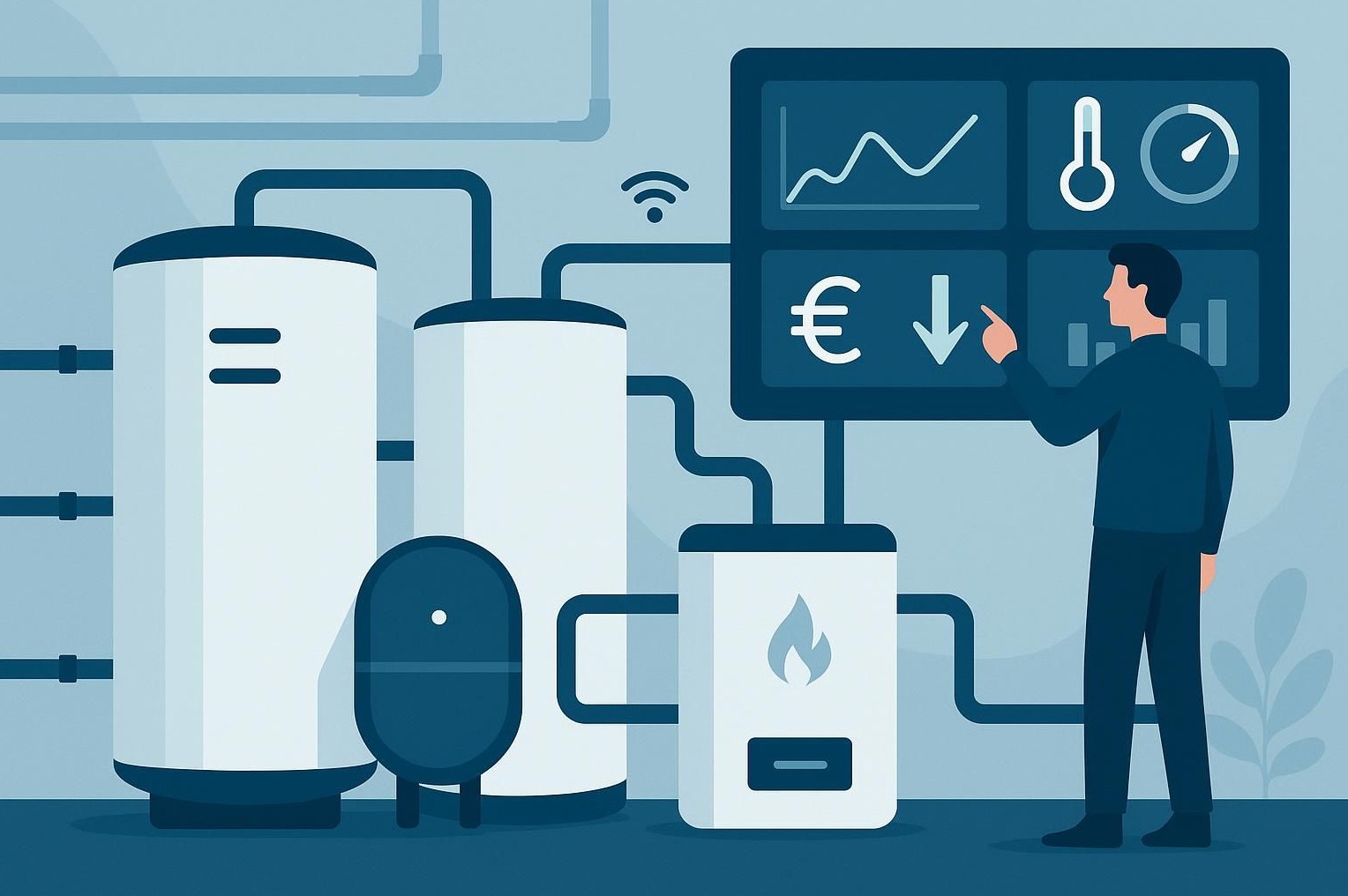
At its core, a digital heating basement consists of four building blocks: sensors and heat meters capture the operating data, and a gateway transmits it to a central data platform that brings everything together. The existing heating system stays untouched; all components sit centrally in the boiler room, outside individual apartments, and connect to almost any existing system regardless of manufacturer.
For context: the term "digital heating basement" is not a legally defined technical term. The consulting firm RITTERWALD describes the market in a market overview from December 2024 using four value-creation stages: basic data capture, hardware installation, data aggregation and system control.
The biggest differences between providers show up at this fourth stage, system control. Some offer pure monitoring and leave data interpretation to the technical team on site, while others actively and automatically adjust the system.
- Temperature sensors: measure supply flow, return flow and outdoor temperature directly at the central system.
- Heat meters: record the heating system's actual energy consumption.
- Gateway: continuously transmits the measured values to a central data platform.
- Data platform: aggregates, visualizes and interprets the operating data for analysis and control.
What Functions Does a Digital Heating Basement Deliver in Daily Operation?
With a digital heating basement, you gain remote monitoring, automated heating optimization and continuous fault detection for your existing system, without ever needing to be on site. How much you actually save in the end depends on how well these three building blocks work together.
KUGU EOS, the Energie-Optimierungssystem (energy optimization system), handles automated optimization. It evaluates operating data and weather values, together with how the building is actually used, and from that builds a digital twin of the building. The heating curve is then continuously adjusted to actual demand, independent of the fixed values set during commissioning. We describe what that looks like in practice in existing buildings in our article on digital heating optimization through the building's digital twin.
KUGU VIS, the Visuelles-Informationssystem (visual information system), covers the other two levels. Through VIS Betriebstransparenz (operational transparency), you see consumption and temperature data, plus efficiency metrics, for each property and across your portfolio. Through VIS Anlagendiagnose (system diagnostics), you spot early when a system is running incorrectly, for example with a permanently too-high supply temperature or a wrongly set heating curve, long before that turns into complaints or high additional payments. You can read more on how system diagnostics uncovers such problems early in our article Heating system diagnostics: spotting faults in existing buildings earlier.
How Much Energy and Cost Does a Digital Heating Basement Save?
Digital heating optimization in existing buildings typically saves 10 to 20 percent on energy and cost across the market, with a comparable reduction in CO₂ emissions. KUGU states an average savings potential of more than 20 percent for its own energy platform and contractually guarantees 12 percent. According to KUGU, this can raise a building's energy efficiency class by up to two levels.
In the pilot project run by Berlin housing company Gewobag, which manages around 75,000 apartments, the 12 percent savings guarantee was met in all ten buildings tested during the 2024/25 heating season, in some cases by a clear margin. Dominik Unger, authorized signatory and head of technical services at Gewobag ED, confirms the result for the company's own portfolio.
One point worth noting: KUGU's figures are manufacturer data, though in the Gewobag case they were independently confirmed by real operating data. How much you save in your own portfolio always depends on the system's starting condition, in other words how far the heating curve and hydraulic balancing were from their optimum before the retrofit.
What Does a Digital Heating Basement Cost in Practice?
Digital heating monitoring is usually billed either as a monthly service flat rate per property, or as an outright purchase with a one-time investment plus annual maintenance and software costs. There is no independent, cross-provider price study so far, and publicly available figures remain scarce.
A concrete reference point comes from a model case in the legal opinion prepared by law firm MASLATON on behalf of dena: for an apartment building with eight residential units, it calculates €150 per month for the entire building under the service model, as an example.
| Cost model | Cost structure | Example calculation (8 residential units) |
|---|---|---|
| Service model (rental/operation) | monthly flat rate per property | €150 per month for the entire building |
| Outright purchase | one-time investment plus annual maintenance and software | approx. €4,000 one-time plus approx. €600 per year |
| Networked smart thermostats (add-on option) | cost per residential unit per month | approx. €15 to €20 per residential unit per month |
The model case from the legal opinion, dated June 17, 2025, serves to clarify the legal classification of operating costs. Treat it as an illustrative calculation example that offers a rough first orientation for budget planning, since no broader market survey exists yet. A 15 percent subsidy from BAFA, Germany's Federal Office for Economic Affairs and Export Control, does exist for "heating optimization." According to the funding guideline, though, it only applies to improving system efficiency in existing buildings with a maximum of five residential units, so it doesn't reach larger apartment buildings and portfolios.
Are the Costs for Digital Heating Monitoring Recoverable From Tenants?
Ongoing service fees for digital heating monitoring count as recoverable operating costs under Section 2 No. 4a of the German Operating Costs Ordinance (Betriebskostenverordnung) and Section 7(2) of the German Heating Costs Ordinance (Heizkostenverordnung), according to a legal opinion commissioned by dena. This applies as long as the fees recur regularly, are contractually agreed and serve to control the central heating system.
Good to know: the roughly 90-page opinion by law firm MASLATON, presented on June 17, 2025 as part of dena's KEDi initiative, clarifies recoverability with legal certainty for the first time. One-time investment and installation costs are excluded from this; owners and landlords bear those themselves.
For property managers and housing companies, that noticeably changes the calculation. The ongoing service fee of an operator model can be passed on to tenants through the operating or heating cost statement, while the one-time investment in your own hardware stays with the ownership side. There's also a data protection point worth watching: sensors installed centrally in the boiler room, outside the apartment, generally don't count as personal data. Sensors inside individual apartments, for example for room temperature, need their own legal basis under GDPR.
Why Does Retrofitting Existing Buildings Pay Off Right Now?
Retrofitting a digital heating basement happens while the building keeps running and can then scale across entire portfolios; no renovation or heating system replacement is required. And right now, two things make waiting the wrong call: new regulations and market momentum.
Under Section 60b of the GEG (Gebäudeenergiegesetz, Germany's Buildings Energy Act), water-based heating systems in buildings with at least six residential or commercial units must be inspected and optimized. For systems installed before October 1, 2009, this deadline runs out on September 30, 2027; for newer systems, it applies within one year after 15 years of operation. If a system already has standardized building automation under Section 71a GEG, the one-time on-site inspection no longer applies. Ongoing digital monitoring then takes over that function by itself, heating season after heating season.
Portfolio example: after a pilot phase, housing company Wohnungsgesellschaft Werdohl switched its entire portfolio, 212 buildings with 1,417 residential units built between 1927 and 2018, to digital heating monitoring. Early results show around 10 percent energy savings, which the company itself describes as a conservative estimate.
Beyond the deadlines, market dynamics matter too. As of June 30, 2025, only around 4.4 percent of apartments in German multi-family buildings had digital heating monitoring installed, while the providers surveyed reported annual growth rates of more than 50 percent. Digitizing your portfolio now secures that head start on data while meeting the upcoming GEG deadlines at the same time. For how to technically connect an existing system, see our article Heating system connectivity: data instead of constant manual checks.
Regulation and Returns Are Converging Right Now
Legal certainty around cost recovery and the time pressure from Section 60b GEG used to be discussed separately. Now both are converging, hitting a market where, according to the KEDi survey, only 4.4 percent of apartments carry digital monitoring so far.
For technical managers and asset managers, three things matter most. The ongoing service fee is recoverable. The inspection requirement can be met digitally. And an early rollout builds exactly the data foundation you'll need later for ESG reports and for optimizations you'll want to make anyway.
A good starting point is a simple inventory. Which properties fall under the inspection requirement by 2027? Which systems are already technically prepared, and where does automated optimization through KUGU EOS and KUGU VIS deliver the most?
Frequently Asked Questions About the Digital Heating Basement
Does the Existing Heating System Need to Be Replaced When Installing a Digital Heating Basement?
No, a digital heating basement adds sensors, meters, a gateway and a data platform to your existing heating system; the boiler itself stays in place. The solutions work independently of manufacturer and can be retrofitted while the system keeps running, even in older existing buildings.
At What Building Size Does the Inspection Requirement Under Section 60b GEG Apply?
From six residential or commercial units upward, water-based heating systems must be inspected and optimized. For systems installed before October 1, 2009, the deadline runs out on September 30, 2027, and newer systems must be inspected within one year after 15 years of operation.
Under What Condition Does Digital Monitoring Replace the Inspection Under Section 60b GEG?
As soon as the heating system has standardized building automation under Section 71a GEG, the one-time on-site inspection under Section 60a/60b GEG no longer applies. Monitoring then takes over that role as an ongoing task during continuous operation.
What Happens If a Heating System Subject to Inspection Misses the Section 60b GEG Deadline?
Under Section 108 GEG, fines of up to €5,000 apply if the inspection is skipped intentionally or through negligence. Introducing digital monitoring early avoids this risk, because it fulfills the inspection requirement continuously.
Do Sensors Inside Individual Apartments Need Their Own Data Protection Basis?
Yes, sensors inside individual apartments, for example for room temperature or humidity, can create an indirect link to personal data and need a legal basis under GDPR, such as consent or a legitimate interest. Sensors located centrally in the boiler room, outside the apartment, generally don't count as personal data.