AI for the Boiler Rooms of the Housing Industry


BundesBauBlatt: The housing industry faces the challenge of consistently leveraging efficiency potential in existing building stock to make Germany's buildings fit for the future. How does KUGU bridge the gap between "simply heating less" and costly energy-efficient retrofitting?
Christopher von Gumppenberg: We optimise heating systems digitally and continuously, without extensive structural measures. The foundation is an individual digital building twin that models the thermal behaviour of each building. Appealing to user behaviour is unreliable and is often perceived as a loss of comfort, while conventional energy-efficient refurbishment is extremely capital- and time-intensive. That is why KUGU takes a practical, low-investment approach: this solution is part of the KUGU Energy Suite, which consolidates all processes related to energy optimisation. At its core is the Energy Optimisation System (EOS), which uses AI-driven algorithms as a control layer to intervene directly in building operations and regulate systems in an automated, demand-responsive manner.
BundesBauBlatt: Can you explain what the solution "sees" in a heating system and which parameters it adjusts for optimisation?
Christopher von Gumppenberg: In many existing buildings, heating runs on fixed schedules, regardless of how actual usage or weather conditions change throughout the day. This leads to energy losses and costs that can be avoided. EOS dynamically adjusts energy supply in 15-minute intervals, based on the digital building twin in combination with operational data, usage patterns, and current weather forecasts. Complementing this, our Visual Information System (VIS) ensures full transparency during ongoing operations: consumption and performance data are displayed in real time and logically interlinked to support informed decision-making across entire portfolios.
BundesBauBlatt: What energy and cost savings can customers realistically achieve in practice?
Christopher von Gumppenberg: On average, we achieve around 20% savings in energy consumption, costs, and CO₂ emissions for our customers — with 12% savings contractually guaranteed. For many asset holders, it is also crucial that the solution can be easily scaled following a successful pilot phase. Thanks to our digital approach, this is straightforward. For example, after a successful pilot with Gewobag, the rollout to 300 systems is currently underway. We now work with more than 75 clients from the real estate and energy sectors — across both residential and commercial property portfolios.
BundesBauBlatt: One challenge facing the housing industry is the heterogeneity of existing building stock. How universal is the KUGU solution for an asset holder managing 10,000 diverse residential units?
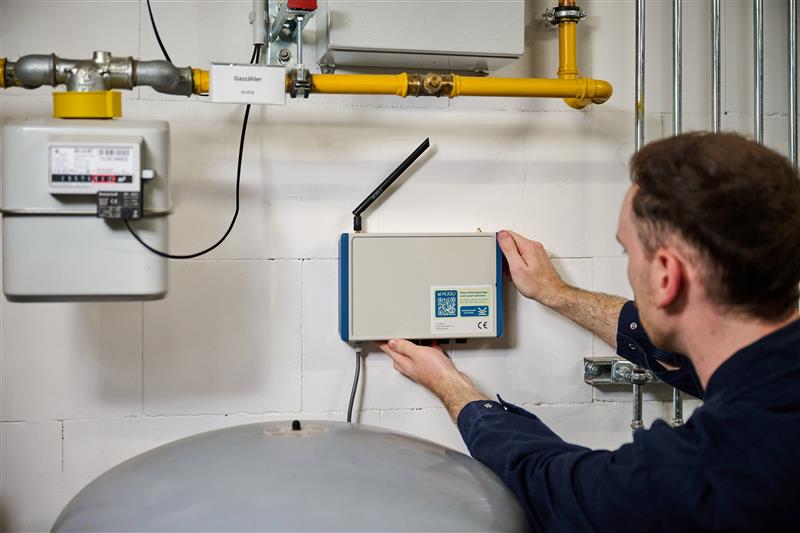
Christopher von Gumppenberg: The heterogeneity of systems — spanning different manufacturers, varying construction years, and diverse energy sources — is one of the greatest obstacles to digitalising real estate portfolios. Our solution is designed precisely for this challenge and offers high connectivity regardless of manufacturer or energy source, whether gas boiler, district heating, or heat pump. Even older, analogue systems can be digitalised through simple sensor integration. All data ultimately converges in our Energy Suite, which transforms the technical patchwork into a transparent, manageable portfolio — enabling unified monitoring across all units.
BundesBauBlatt: The skills shortage is also affecting the housing industry. How can KUGU help to offset the lack of qualified technicians?
Christopher von Gumppenberg: Our digital approach also pays dividends in maintenance: thanks to early detection of anomalies, issues can be resolved before they escalate. Sensors report irregularities — such as sudden temperature drops or elevated consumption levels — and automatically trigger alerts. Rather than spending valuable working time on routine inspections or time-consuming on-site troubleshooting, KUGU transforms the service process into targeted, data-driven maintenance. This allows scarce technical capacity to be deployed more efficiently, without compromising service quality.
BundesBauBlatt: What role does heating system optimisation play in a building that has already undergone energy-efficient modernisation? Does efficiency improvement remain a central concern even then?
Christopher von Gumppenberg: It is a common misconception that an energy-retrofitted building or a modern heating system runs itself. Even with an improved building envelope, further efficiency potential can be unlocked during ongoing operations — for instance through more precise assessment of the technical condition of systems and through an operating mode that takes economic signals from the energy market into account. I very much look forward to presenting new functionalities for the KUGU Energy Suite at our KUGU Days at the end of May. They mark a further development milestone towards an even more economically efficient building operation. This makes it clear: even in retrofitted buildings, there remain concrete opportunities to reduce energy consumption, emissions, and costs.
You can read this article in the BundesBauBlatt 5/26, find it here.