Heating of the Future: Technologies and Costs in Existing Buildings

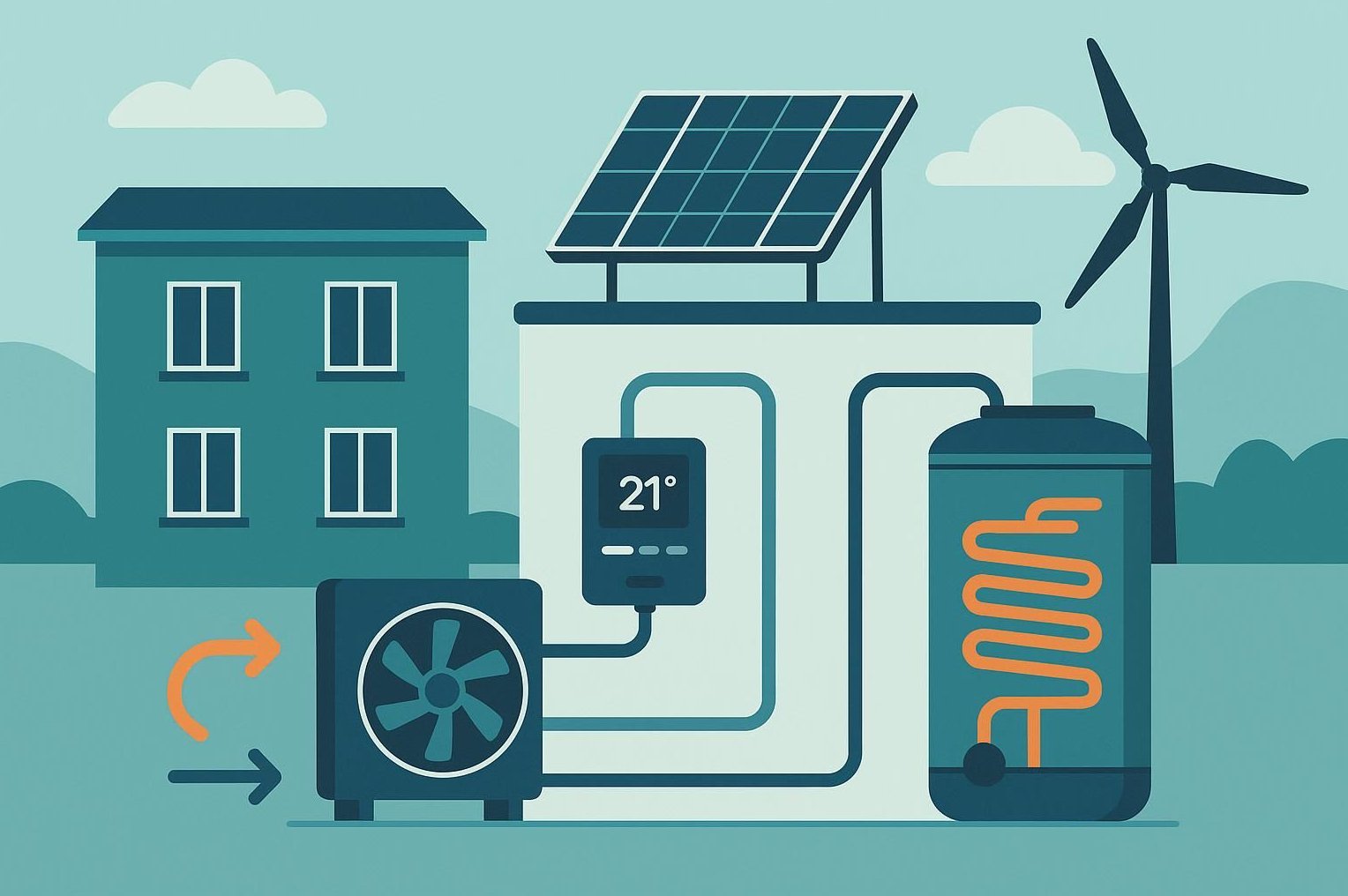
The heating of the future is changing in 2026 mainly through control and connectivity, not through any single new piece of hardware. Heat pumps, district heating and digital operational control together decide how much housing companies can cut energy costs and CO₂ emissions across their existing portfolios. For portfolios with older buildings, the real question is what can be achieved economically without a full-scale renovation.
For technical directors and managing directors in the housing industry, 2026 is no longer about whether heat pumps or district heating are viable technologies at all. Heat pumps, district heating and heat networks have already established themselves as the load-bearing technologies. What matters now is how existing systems can be optimized during ongoing operation, through sector coupling and digital control, without renovating every single building.
Three developments currently determine how quickly this shift pays off in existing buildings:
- The German Building Modernization Act (GModG) has replaced the rigid 65 percent rule since July 29, 2026, with a rising CO₂ cost burden for inefficient buildings.
- Heat pumps and heat networks are set to cover around 79 percent of heat supply, according to current municipal heat plans.
- AI-based heating control unlocks 10 to 25 percent energy savings without any construction work, according to demonstration projects.
- Dynamic electricity tariffs and Section 14a of the German Energy Industry Act (EnWG) have made coupling heat pumps to electricity prices economically measurable since 2025.
Heat pump, district heating or hybrid: what carries the heating of the future in existing buildings?
Heat pumps and district heating from heat networks carry the heating of the future in existing buildings. Hybrid systems with a fossil component, on the other hand, are losing economic relevance. An analysis of 938 municipal heat plans by the Öko-Institut and Fraunhofer ISE shows that heat pumps are expected to cover 42 percent and heat networks 37 percent of heat supply, together roughly four-fifths of demand (Cleanthinking's analysis of municipal heat plans). Right now, natural gas still covers 61 percent and heating oil 15 percent of municipal heat demand. That balance is set to shift considerably over the coming years.
Heat pumps as the backbone in multi-family buildings
The German Heat Pump Association expects sales of around 330,000 units in 2026, a rise of roughly 10 percent year on year, after the entire German heating market fell to its lowest level in two decades in 2025 with 627,000 units sold. In the first quarter of 2026 alone, KfW issued 89,631 heating subsidy approvals, around 89 percent of them for heat pump projects. For existing portfolios, another figure matters just as much: roughly 20 percent of German multi-family buildings already sit in energy efficiency classes A and B, and over half fall into the mid-range classes C to E, meaning most are already suitable for low-temperature operation. The cost of retrofitting a heat pump into a multi-family building varies widely depending on the source and system size, ranging from around 28,000 to 120,000 euros. Where you land within that range depends mainly on system size and the distribution setup, plus the number of residential units involved. Retrofitting gets more complex in multi-family buildings than in single-family homes, simply because every unit needs its own supply.
District heating and heat networks are growing noticeably in existing buildings
Around 3,800 district heating and heat networks are currently in operation across Germany, supplying about 14 to 15 percent of households, roughly 15.2 million homes. The share of renewable energy in district heat generation has grown from 6.9 terawatt-hours in 2005 to more than 24 terawatt-hours in 2024, an increase of around 340 percent. A BBSR analysis of 342 submitted municipal heat plans also points to a possible fourfold increase in the number of heat networks: once municipal heat planning is complete, heat networks could be available in around 37 percent of municipalities. In many municipalities, the fundamental decision in favor of a heat network has already been made. For existing buildings, the only remaining question is often just when the connection happens.
Why hybrid heating systems are losing economic ground
Hybrid heating systems with a fossil component are losing economic appeal. The climate speed bonus has been dropping since July 21, 2026, from 20 to 16 percent, and will keep shrinking every six months after that, while a rising bio-blending obligation for fossil-fuel heating shares kicks in from 2029. Only the heat pump component of a hybrid system remains eligible for funding; the fossil share no longer qualifies. For existing portfolios still weighing hybrid solutions, this shifts the economics noticeably toward pure heat pump or district heating setups.
Why does AI-based control decide the economics of tomorrow's heating?
Whether a heating system runs economically in 2026 depends more on its control logic than on the type of system itself. Around 50 percent of all heating systems in Germany run poorly, outdated or incorrectly configured, according to the German Heating Industry Association (BDH) (Vodafone's analysis of AI-driven heating optimization). This is exactly where AI-based systems step in, and the numbers back it up. Field trials using manufacturer-independent heating monitoring show average savings of around 24 percent, and the SECAI research project reached up to 18 percent in its very first heating season, purely by lowering flow temperature by 3 degrees. Evaluations of EU and federal demonstration projects in non-residential buildings point to an additional 10 to 25 percent savings potential in heating demand.
A digital building twin turns this reactive way of running a system into demand-based control. The system stops heating on a hunch. It reacts continuously to weather, usage and its own current performance. At KUGU, this digital twin forms the basis for KUGU EOS, the Energie-Optimierungssystem (energy optimization system), which continuously adjusts flow temperature and the heating curve to real weather and usage data.
What a digital building twin actually does: A digital building twin maps a real heating system together with weather data, usage profiles and system behavior in digital form. This data foundation allows operation to be continuously simulated and adjusted, instead of setting heating curves once and leaving them untouched for years.
For housing companies with many properties, the key point is that this effect scales: the same optimization logic works just as well on a single system as across an entire portfolio, without needing to reprogram every building individually.
How does sector coupling work between heat, electricity and dynamic pricing in existing buildings?
Sector coupling means heat generation and the electricity side get controlled together. When the heat pump runs then depends on storage levels and the current electricity price. This pays off especially for buildings with a heat pump, since its electricity consumption can be shifted deliberately into cheaper market phases. The exchange electricity price averaged around 10 cents per kilowatt-hour in 2025 and 2026, but swung wildly around that average: the 2025 peak hit 58.3 cents, while the lowest, a negative value, reached minus 25 cents (reduco.ai's analysis of exchange electricity price data). In negative-price hours, consumption even gets paid for.
Good to know: Since January 1, 2025, every electricity supplier in Germany has been required to offer at least one dynamic electricity tariff (Section 41a EnWG). Under Section 14a EnWG, operators of controllable consumption devices such as heat pumps also receive a reduced grid fee, ranging from roughly 150 to 360 euros per year depending on the chosen module. In return, the grid operator may temporarily throttle the system to as low as 4.2 kilowatts during acute local grid overload.
This is where EOS Strompreisdynamik comes in, a mode within KUGU EOS that factors the forecast market electricity price from the power exchange into heating optimization. This model is particularly relevant for buildings with heat pumps and sector-coupled energy systems, and it can be weighted between energy efficiency and electricity costs depending on your priorities. What that means in concrete savings is covered in the article Strompreisdynamik im Gebäude nutzen, while Sektorenkopplung im Gebäude explains how heat and electricity are technically brought together.
What's already possible in existing buildings today, without a full renovation?
Without a full renovation, far more is already achievable in existing buildings than most portfolios currently use. A good fifth of multi-family buildings are already efficient enough for low-temperature operation, and over half sit in mid-range efficiency classes where at least parts of the building already qualify. The first realistic step is usually the digital optimization of the existing central heating system, well before any equipment gets replaced.
With digital heating control, you put measurement and weather data to continuous use to run the system correctly, without touching the boiler, heat pump or distribution system. The article Digitale Heizungssteuerung im Bestand describes how this shift works during ongoing operation and what a building needs to bring to the table. For portfolios with a mixed building age, this is exactly what pays off fastest, well before the big renovation decisions come up.
How does the heating of the future pay off in existing buildings: costs, funding, savings?
The heating of the future pays off in existing buildings mainly when operational optimization and regulation are thought through together. The Building Modernization Act replaced the previous Buildings Energy Act on July 29, 2026; the rigid 65 percent rule for new heating systems is gone, and in its place a gradually rising bio-blending obligation for fossil heating systems kicks in from 2029 (the German federal government on the Building Modernization Act). Adjusted funding conditions have also applied since July 21, 2026: the KfW heating subsidy cap dropped from 30,000 to 28,000 euros in eligible costs per residential unit, the income bonus was tiered, and a new child supplement was introduced.
The CO₂ Cost Allocation Act in brief: Since the amendment under the GModG, the law tiers the landlord's share of CO₂ costs across ten levels based on building quality. Highly efficient buildings cost landlords nothing, while for the least efficient buildings, those emitting more than 52 kilograms of CO₂ per square meter per year, landlords bear up to 95 percent of the CO₂ costs (Verbraucherzentrale Energieberatung on CO₂ cost allocation).
For portfolios sitting in a weak efficiency class, this turns operational optimization into a direct cost lever. KUGU guarantees its customers a minimum of 12 percent energy savings and achieves over 20 percent average savings in energy, costs and CO₂ emissions, in some cases paired with an efficiency class improvement of up to two levels.
Gewobag pilot project, winter 2024/25: Across ten existing Berlin buildings, KUGU saved around 260,000 kilowatt-hours of energy between October 2024 and March 2025. That translated into more than 50 tons of CO₂ and over 18,000 euros in energy costs, all without any renovation work. The 12 percent savings guarantee was met or exceeded in every one of the ten buildings, and the rollout is now being expanded to 250 systems (Wohnungswirtschaft-heute on the Gewobag pilot project).
Another example shows just how much this can move the needle in a single building: in a Berlin multi-family building from the 1980s with 1,800 square meters of heated space and twelve residential and commercial units, KUGU's digital twin cut energy consumption by 27 percent, without a single structural change to the central gas condensing boiler. With numbers like that, the CO₂ target turns into an entirely ordinary investment calculation. And the savings land directly in the operating cost statement.
Control intelligence becomes the deciding factor for profitability
Heat pumps and district heating remain the load-bearing technologies. But whether that pays off in existing buildings increasingly comes down to how intelligently the system is run. The CO₂ Cost Allocation Act now makes inefficient operation immediately more expensive for landlords, and AI-based control provides exactly the lever that lowers those costs in the short term, without waiting for the next wave of renovations.
For housing companies, this has a practical implication: look at the operating data of your existing system first, before the next boiler replacement or major renovation is even on the table. Digital operational optimization, and where a heat pump is already installed, coupling it to dynamic electricity prices, can often be implemented within a single heating season, and the resulting savings now show up directly in the operating cost balance thanks to the new regulation.
Frequently asked questions about the heating of the future in existing buildings
Does a heat pump already pay off in an unrenovated multi-family building today?
Yes, in many cases even without major structural preparation. Around 20 percent of German multi-family buildings already sit in energy efficiency classes A and B, and over half fall into the mid-range classes C to E, which usually makes them low-temperature ready enough to run a heat pump. Exact suitability depends on the condition of the heating surfaces and the distribution system in the building.
What costs should housing companies expect for a heat pump retrofit in a multi-family building?
A realistic range runs from around 28,000 to 120,000 euros, depending on building size, distribution system and the number of residential units. Current market analyses document this range inconsistently, so each building should be assessed individually. System size and the effort required for unit-by-unit distribution are the main cost drivers.
How does the CO₂ Cost Allocation Act change the cost split between tenants and landlords?
The landlord's share of CO₂ costs rises in ten tiers, from 0 percent for highly efficient buildings to 95 percent for the least efficient buildings emitting more than 52 kilograms of CO₂ per square meter per year. This tiering has applied since the amendment under the Building Modernization Act. For existing portfolios with a poor efficiency class, that makes operational optimization a direct cost lever.
Does the existing heating system need to be replaced to benefit from digital control?
No, digital heating optimization typically works with the existing central heating system, without replacing the boiler, heat pump or distribution system. In one documented case, a Berlin multi-family building from the 1980s, digital control alone cut energy consumption by 27 percent, with no structural changes at all. The usual requirement is simply connecting the existing control technology to the optimization software.
What funding rates apply to heating replacements in existing buildings since 2026?
Since July 21, 2026, the KfW heating subsidy cap (BEG) sits at 28,000 euros in eligible costs per residential unit, down from 30,000 euros previously. The income bonus is tiered and reaches up to 40 percent for households earning less than 30,000 euros a year, topped up by a new child supplement. For hybrid heating systems with a fossil component, funding now applies only to the heat pump share.