Dynamic Electricity Pricing in Buildings: Where It Really Pays Off

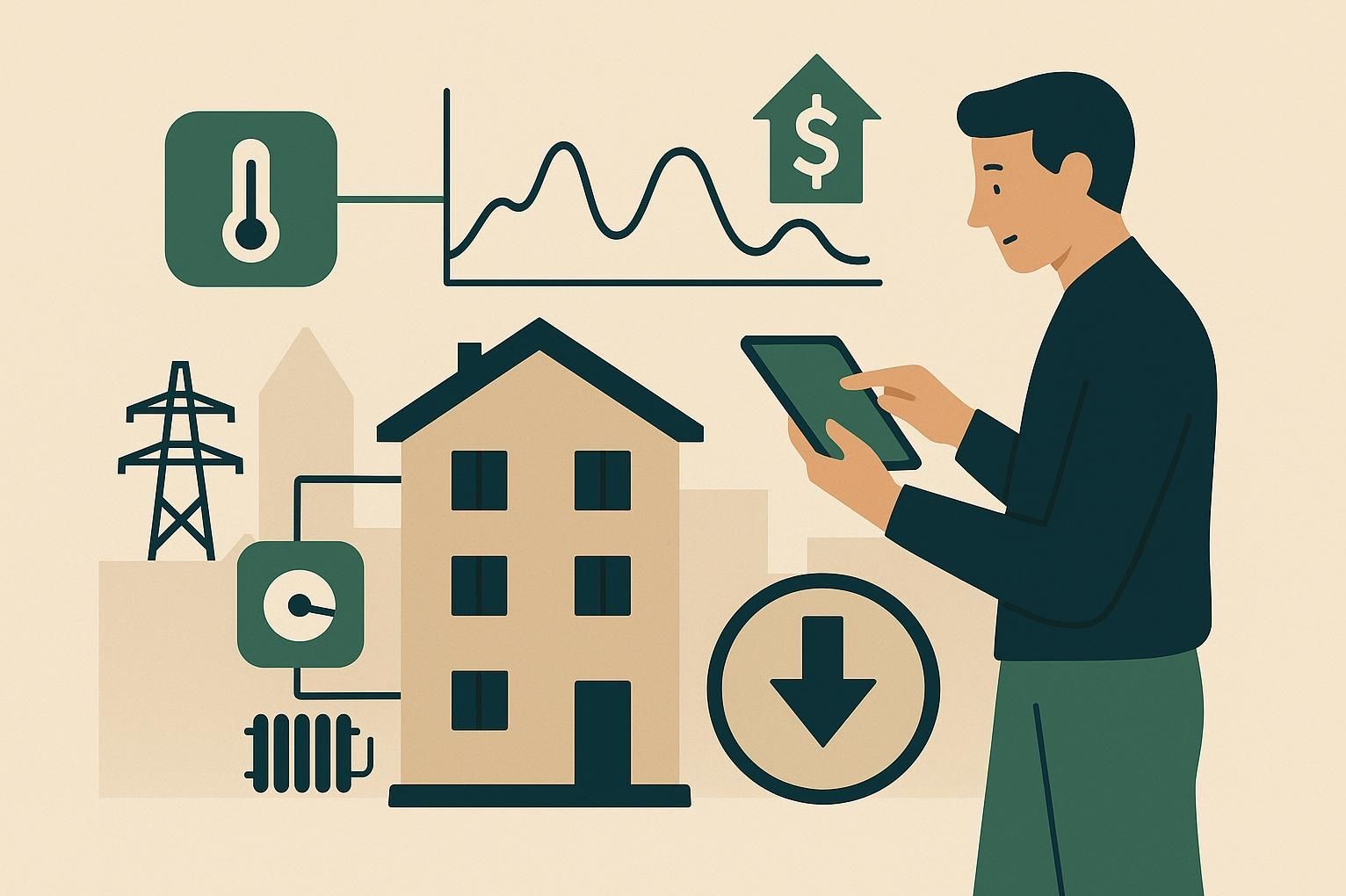
Dynamic electricity pricing in buildings means running heat pumps, storage and shiftable loads during hours when wholesale power is cheap or even negative. The savings show up where a system is remotely controllable, can store heat or electricity, and runs on automated control. A dynamic tariff alone will not get you there.
The regulatory push behind this is new, and it is binding. Since 2025, every electricity supplier in Germany has been required to offer dynamic tariffs, and since 1 April 2025 a time-variable grid fee module for controllable consumption devices has applied on top of that. For housing companies, a building's technical equipment ultimately decides the real-world effect; the legal framework only sets the stage for it.
- Heat pumps with buffer storage benefit most from price windows and grid-fee discounts under Section 14a of the German Energy Industry Act (EnWG).
- €130 per megawatt-hour was the average day-ahead price spread in 2025, with 573 hours of negative prices.
- Nationwide, only 23.3 percent of mandatory cases are equipped with smart metering systems so far.
- Automated control links price signals to comfort limits without putting tenants or building systems at risk.
Where Does Dynamic Electricity Pricing Actually Pay Off in Buildings?
Dynamic electricity pricing pays off wherever consumption can shift in time and a control system actually uses that flexibility. Four operating situations show this most clearly: heat pumps with thermal storage, battery storage, shiftable loads such as EV wallboxes, and central heating systems across a portfolio.
Heat Pumps With Buffer Storage
Without added flexibility, the tariff savings on a heat pump alone stay modest, according to a short study by Neon Neue Energieökonomik commissioned by Naturstrom. Combine intelligent system control with the grid-fee discount from Section 14a modules 1 and 3, and the savings potential climbs to up to 25 percent of the electricity bill. A completed Fraunhofer ISE research project covering 77 heat pumps in existing buildings measured seasonal performance factors (SPF) of 3.4 for air-to-water systems and 4.3 for ground-source systems, ranging from 2.6 to 5.4. Those figures come from single-family and two- to three-family homes, so they translate only loosely to large multifamily portfolios, yet they point in a clear direction: the higher the seasonal performance factor, the more room there is to shift load toward cheaper hours.
Battery Storage and Peak Shaving
Battery storage in buildings pays off mainly through peak shaving and by shifting electricity purchases into low-price hours. An industry-press example for commercial peak shaving puts annual savings at around €45,000 for 300 kW of shaved peak load and roughly 500 kWh of storage capacity, against an investment of €200,000, which works out to a payback period of about 4.5 years. That figure comes from one specific load profile, and results shift from building to building: whether a storage system pays for itself depends on the load profile, the demand charge and the actual number of cycles achieved on site.
Shiftable Loads, Central Heating Systems and Portfolio-Wide Control
EV wallboxes, night-storage heaters and other controllable consumption devices with a connected load of 4.2 kW or more have fallen under Section 14a EnWG since 2024, which means they can be shifted into low-price windows by regulation. For central heating systems, the effect only becomes relevant once the system is digitally connected. Across a larger portfolio, the effect grows substantially: in a pilot project with Berlin-based housing company Gewobag, KUGU's optimization saved around 260,000 kWh of energy, more than 50 tonnes of CO₂ and over €18,000 in energy costs across ten equipped buildings between October 2024 and March 2025, with a rollout to 250 systems planned.
What Do Existing Buildings Need for Dynamic Electricity Pricing to Work?
Dynamic electricity pricing works only once four building blocks come together: reliable meter and consumption data, an active tariff connection, genuine controllability of the system, and organizational sign-off to intervene in operations automatically. Miss any one of these, and price optimization stays theoretical.
The tariff connection is now backed by law. According to the Bundesnetzagentur, Germany's Federal Network Agency, every electricity supplier in the country has had to offer at least one dynamic tariff since 1 January 2025; before that, the requirement applied only to suppliers with more than 100,000 end customers. A building without access to that tariff cannot receive price signals in the first place.
Right now, the data foundation is the tightest bottleneck. The statutory smart meter rollout began on 1 January 2025 for end customers with an annual consumption above 6,000 kWh, PV systems from 7 kW upward and controllable consumption devices, with target rates of 50 percent by the end of 2028 and 95 percent by the end of 2030. Yet according to an analysis of Bundesnetzagentur figures for the fourth quarter of 2025, only 23.3 percent of mandatory installation cases were actually equipped with an intelligent metering system, even though the capped costs for it run on a sliding scale of roughly €20 to €140 per year.
Good to know: Section 14a EnWG distinguishes three modules. Module 1 pays a flat grid-fee reduction of €110 to €190 gross per year, module 2 lowers the grid usage charge to 40 percent of the base rate, and module 3 additionally ties the grid fee to time-variable tariff periods. Which module makes sense depends on the individual consumption profile; see the assessment from Netze BW for more detail.
In practice, controllability means the system has to process weather data, system status and price signals in real time, or every tariff optimization stays a manual compromise. And because automated control reaches into the ongoing operation of central heating systems, it needs explicit sign-off from technical facility management, including clearly documented limits for temperature and system load.
The Economics Behind Dynamic Electricity Pricing: Price Windows, Grid Fee Modules and Cost Drivers
How much dynamic electricity pricing actually delivers cannot be reduced to a single percentage. Price windows on the day-ahead market, the Section 14a grid-fee modules and the complexity of the specific system together determine what actually ends up on the bottom line.
On the market side, the volatility is real and growing. According to the Forschungsstelle für Energiewirtschaft (FfE), the average daily price spread on the EPEX Spot exchange came to around €130 per megawatt-hour in 2025, against an annual average of about €89.3 per megawatt-hour. 2025 also set a new record with 573 hours of negative wholesale electricity prices, more than four times the number recorded in 2021. Every one of those hours is real money for buildings whose systems can actually respond to it.
On the cost side, housing companies need to look more closely. Fraunhofer IEG cites an average savings potential of up to 30.4 percent for heat pumps, but only when an energy management system is in use; that figure, too, is based on individual households and single-family homes, which limits how far it carries over to a multifamily portfolio average. The practical guide from dena, Fraunhofer ISE and GdW names the biggest cost driver in existing buildings: domestic hot water preparation and rigid hydraulics stand out as the largest efficiency brakes in multifamily buildings, because they force high flow temperatures and narrow the room for price optimization from the outset.
That is why KUGU calculates conservatively, with a contractually guaranteed minimum saving of 12 percent on heating energy and an average of more than 20 percent across energy, cost and CO₂, provided the building is in stable condition without serious hydraulic faults. Another cost factor that often gets overlooked is the CO₂ price itself: from 2026, Germany's national emissions trading scheme moves to an auction system for the first time, with a price corridor of €55 to €65 per tonne, which adds extra value to every kilowatt-hour of heating energy saved.
How Can Price Optimization Work Alongside Comfort and System Protection?
Price optimization only works within fixed comfort and safety limits that need to be defined before any price-based control begins. Temperature management and system protection act as the ceiling here: the control system can use favorable price windows, but never outside the permitted flow and room temperatures or at the expense of the building systems.
For operators of central heating systems, Germany's Buildings Energy Act (GEG) sets these limits clearly. Under Sections 58, 59 and 60b GEG, systems have to be operated properly by trained personnel, and buildings with six or more residential units on a water-based heating system are also subject to a mandatory inspection and optimization requirement. Ignoring these duties risks inefficient operation and personal liability for the operator.
EOS Temperaturführung operates exactly at this boundary, releasing price signals only within the permitted comfort and safety parameters. In practice, that means a heat pump can shift forward into a low-price hour and charge the buffer storage more heavily, but only as long as domestic hot water temperature, Legionella protection and the system's technical limits stay within range. Only then does the control genuinely pay off in a multifamily building.
How Do Housing Companies Roll Out Automated Electricity Price Optimization?
The realistic path to rollout starts with monitoring. That is what creates transparency over consumption and cost, and automated optimization builds on that foundation. Skip that sequence and jump straight to automation, and you risk faulty control, because the data foundation needed to make sense of price signals is not there yet.
The first step calls for complete consumption, weather and system data, the kind an AI-based analysis of operational data delivers. Only once that data foundation is in place can you assess which buildings in a portfolio actually bring enough flexibility for price optimization. The second step is where transparency shows where energy is genuinely being lost during ongoing operation, an effect also visible in two older buildings in Leipzig with 10 and 21 residential units respectively: energy consumption there dropped by 39 percent and 33 percent within two months, equivalent to €850 in cost savings and a 2.4-tonne reduction in CO₂. That reading falls within the spring shoulder season, when consumption is naturally lower, which is why it looks higher than a full-year figure would; even so, it shows real potential for data-based system control in existing buildings.
Automated optimization only kicks in at the third step: EOS Strompreisdynamik combines weather, consumption and system data with live electricity price signals and controls operations so that heat pumps and heating systems run at their economic optimum, within the comfort and safety limits set in advance.
In practice, this means the technical foundation via the KUGU Energieplattform can be built up step by step, without every building in a portfolio needing automated control from day one. What matters more is starting with the properties that already have smart meters, buffer storage or controllable heat pumps, and bringing the rest of the portfolio on board as the ongoing smart meter rollout progresses.
Dynamic Electricity Pricing Becomes Part of Everyday Operations
The effect only becomes substantial once price signals, weather data and system status flow together in a single control system. That has little in common with simply switching tariffs anymore. It is precisely this kind of control that separates portfolios that genuinely benefited from the 573 hours of negative electricity prices in 2025 from those that had no technical way to use those windows at all.
For housing companies, the practical takeaway is clear. Close the data gap. Define sign-offs and comfort limits for automated control. Then switch price optimization into productive use once both of those steps are in place. Follow that order, and you save measurable costs at the end of it, stay legally compliant, and tenant comfort does not suffer along the way.
Frequently Asked Questions About Dynamic Electricity Pricing in Buildings
At What Building Size Does Dynamic Electricity Pricing Pay Off?
The deciding factor is the technical equipment already in place; how many residential units a building has plays only a minor role. Buildings with a heat pump, buffer storage or battery storage and active control benefit starting from just a few units, while inflexible existing systems without storage capability show barely any effect even at portfolio scale.
What Role Does the Smart Meter Rollout Play for Dynamic Pricing in Existing Buildings?
It is currently the biggest bottleneck: nationwide, only 23.3 percent of mandatory cases are equipped with an intelligent metering system so far. Without that metering system, price and consumption cannot be matched at 15-minute intervals, and that match is exactly what every price-based control needs.
How Does Section 14a EnWG Affect Grid Fees for Heat Pumps?
Three modules are available. Module 1 cuts the grid fee by a flat €110 to €190 per year, module 2 brings it down to 40 percent of the usage charge, and module 3 additionally ties it to time-variable periods. The rule applies to heat pumps, wallboxes and storage systems with a connected load of 4.2 kW or more that have gone into operation since 2024.
Does Price Optimization Put Domestic Hot Water Hygiene at Risk in Multifamily Buildings?
No, as long as the control system defines Legionella protection and minimum temperatures as fixed limits in advance and only optimizes prices within those limits. For central systems, that interplay is exactly what determines the outcome.
What Operator Duties Apply to Automated Heating Control Under the GEG?
Violations carry liability risk for the operator, which is why Sections 58, 59 and 60b GEG require trained personnel to operate the system properly. Buildings with six or more residential units on water-based heating face an additional inspection and optimization requirement, regardless of whether the control runs manually or automatically.