Submetering Software: Capturing Consumption Data and Billing Digitally

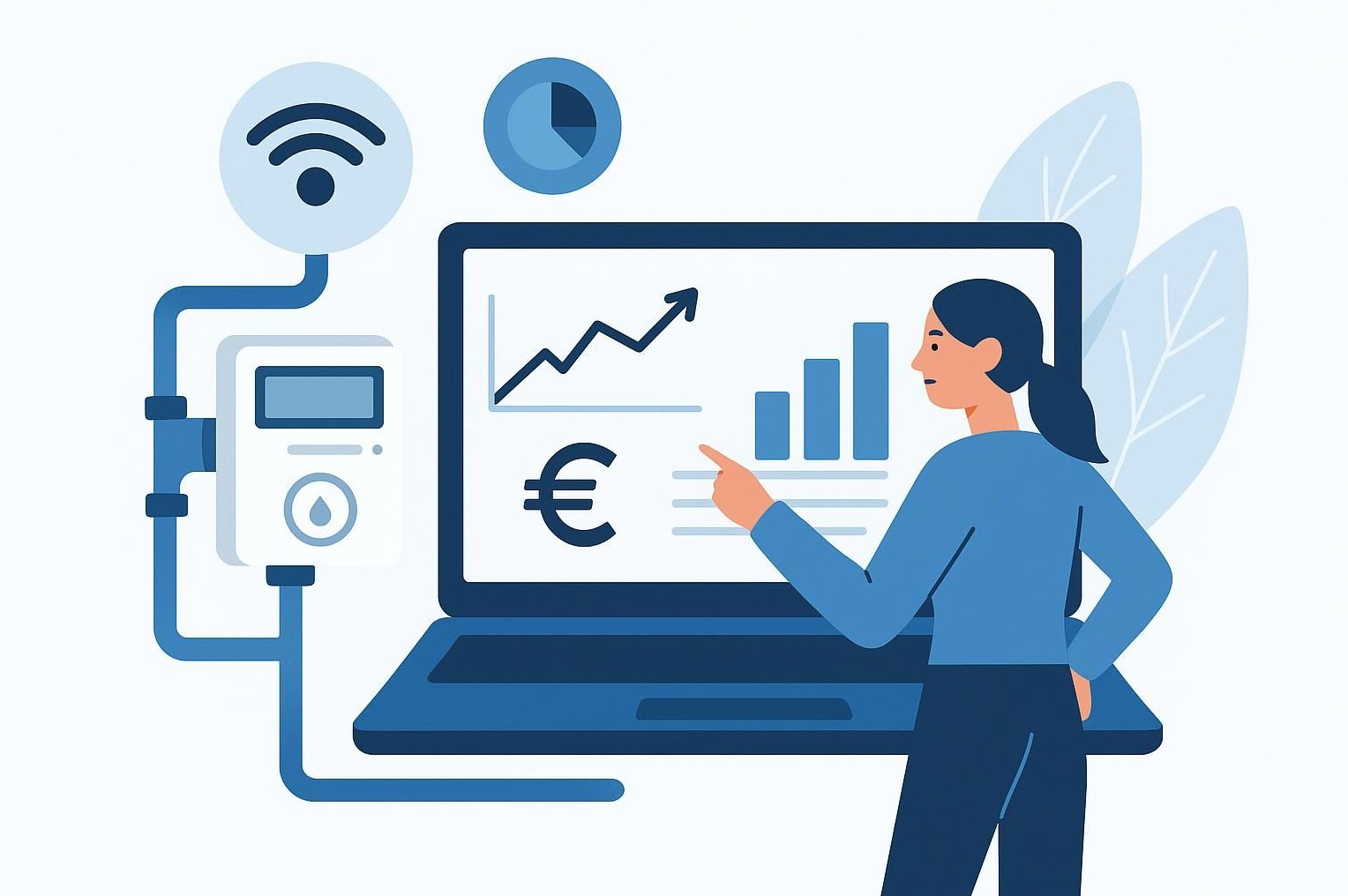
Submetering software digitizes the entire chain from consumption data capture to heating and operating cost billing, reading meters remotely, checking the data automatically and billing users directly. For metering service providers and housing companies, that turns scattered meter-reading rounds and isolated standalone systems into one continuous digital process.
The timeline for this is now firmly set. All existing meters need to be converted to remote reading by the end of 2026, and from 2027 the monthly interim consumption information (uVI) becomes mandatory across the board. That is exactly the moment you find out, in daily practice, whether a piece of software genuinely helps or just creates extra work.
Three factors decide whether a solution really holds up in the daily routines of property managers and metering service providers:
- Remote-readable meters and automated data checks replace manual meter-reading rounds and spreadsheet billing across your portfolio.
- Open interfaces to ERP, DATEV and property management systems prevent duplicate data entry and gaps between systems.
- The transition period for existing meters ends on December 31, 2026, after which the monthly uVI obligation applies across the board.
- KUGU AbSys already handles automated annual billing for more than 500,000 units today.
What Does Submetering Software Actually Do for Metering Service Providers and Property Managers?
Submetering software brings the entire path from meter reading to finished invoice together on one digital platform. In the past, reading cards, standalone scheduling software and a separate billing program all ran side by side. Today, data capture, validation and billing run in a single system.
- Automated, remotely readable consumption data: Data from heating, water and heat meters is captured wirelessly, without anyone needing to enter the unit.
- Centralized data management: Consumption values are validated, stored historically and prepared for both billing and the uVI.
- Heating and operating cost billing: Cost categories, allocation keys and legal requirements flow automatically into the annual statement.
- Interfaces and middleware: ERP, DATEV and property management systems connect without any manual data export.
- User portal: Tenants, owners and property managers see consumption data directly online, including the monthly uVI.
Weak consumption data undermines everything that follows: even the best billing logic still produces the wrong figures if the underlying readings are off, and without a portal you end up sending out the uVI by hand every month. Anyone who traces the path from a classic energy company to a digital metering service provider quickly sees that submetering today is about far more than simply reading meters.
The uVI in brief: The interim consumption information is the monthly notice on heating and hot water consumption that landlords and property managers must provide under Section 6a of the German Heating Costs Ordinance (HeizkostenV) once remote-readable meters are installed.
Why Does the Heating Costs Ordinance Make 2026 the Deadline for Submetering Software?
The amended Heating Costs Ordinance has required, since December 1, 2021, that only remote-readable metering devices may be installed for new installations or scheduled replacements, and the monthly uVI obligation has applied since January 2022. For existing devices without remote reading, the transition period ends on December 31, 2026, after which the obligation applies everywhere.
Newly installed remote-readable devices must also be interoperable and connectable to a smart meter gateway. Older remote-readable meters without this capability can still be retrofitted until the end of 2031, according to Kreiter Immobilien, which gives property managers a bit more breathing room on this particular point.
A VDIV survey of more than 300 property management firms offers a snapshot: with nearly two years left before the deadline, 58 percent of owners' associations and 61 percent of rental properties already had remote-readable devices installed. The hardware is therefore already in place across much of the housing stock; the real question is whether the software behind it also delivers the monthly uVI automatically.
Right to a deduction, up to 21 percent: If landlords fail to meet the remote-reading or uVI obligations, tenants and owners are entitled to reduce their cost share. According to Broschke Hausverwaltung, these deduction rights can add up to as much as 21 percent of heating costs when several violations occur at the same time.
What Problems Does Digital Consumption Data Capture Solve for Metering Service Providers and Housing Companies?
The individual meter reading is rarely where things go wrong. Trouble tends to show up where systems are supposed to connect to each other: consumption data and master data often sit in separate programs, billing logic frequently runs in a third system on top of that, and every interface in between costs time.
The VDIV sums up the market picture well: metering service providers have built numerous products for the new HKVO standards, but most of them remain proprietary standalone systems that leave customers struggling to keep an overview. Property managers who work with several metering service providers at once end up juggling multiple portals and data formats for what is, at the core, the same task.
The GdW raises another point in its position paper on digitalizing the housing industry: rising demands for cost-efficient management and growing legal requirements make digital solutions practically unavoidable, made more pressing by the shortage of skilled staff in the industry. Clear political and legal frameworks for this are still missing, according to the GdW. Every time consumption figures get transferred by hand or corrected after the fact, billing errors creep in. Those errors end up with the tenant, and then land back on your desk as a formal objection.
And then there's the question of scale. Germany counted around 44 million dwellings at the end of 2025, 23.6 million of them in roughly 3.5 million multi-family buildings, according to Destatis, submetering's primary target segment. A portfolio usually grows faster than a property manager can hire staff for the billing team, and the software has to keep pace with exactly that speed.
What Should You Look for When Choosing Submetering Software?
For software to genuinely make your day-to-day work easier, four things matter:
- Integration capability and interfaces: Check whether the software connects uVI data, ERP systems and billing programs without any manual export.
- Scalability across large portfolios: The platform needs to process several hundred thousand units without staffing needs growing at the same rate.
- Degree of automation: The more validation and approval steps run automatically, the less rework piles up at year-end.
- Future AI support: Look at whether the provider already has AI-supported billing processes concretely in development.
The uVI in particular makes a good practical test for integration capability. Software that only processes consumption data once a year for billing has to build additional processes to cover the monthly mandatory notice. When the uVI instead runs from the same data pipeline as the annual statement, no duplicate effort is needed.
How Do KUGU AbSys and Portal 2.0 Put These Requirements into Practice?
The KUGU Messdienstplattform with AbSys (Abrechnungssystem, or billing system) automatically bills the heating and operating costs of more than 500,000 units every year, which already answers the scaling question in live operation. AbSys brings automated consumption data capture, data management and billing logic together on one platform, avoiding the scattered standalone systems that otherwise show up often in this market.
In October 2025, KUGU introduced the new Portal 2.0 for users, together with a clearer product structure built around the Energy Suite and the Submetering Suite. Through the portal, tenants and owners see their consumption data and the monthly uVI directly online, while property managers keep an overview of every unit at once, without having to compile and send out the figures by hand.
At the AbSys user day during KUGU Days 2026, KUGU presented a new middleware layer in June 2026 that links AbSys more closely to Portal 2.0, the data pipeline and external interfaces. For the coming months, the company has also announced AI agents for billing processes, according to 50komma2, which are meant to take this automation a step further.
On the technical side, AbSys connects to ERP systems such as Aareon and SAP, as well as DATEV and casavi, through open interfaces. On the metering side, the platform is manufacturer-independent, working with sensors from various providers and common wireless networks.
- ERP and property management software: Aareon, SAP, DATEV, casavi.
- Data exchange: ARGE/BVED standard 2.1 to 3.10 for switching between metering service providers.
- Metering hardware manufacturers: Engelmann, QUNDIS, Sontex, Lobaro and others, integrated on a manufacturer-independent basis.
- Networks and gateways: Smart meter gateways, LoRaWAN via Zenner Element IoT, Vodafone GK 4.0.
If you want to dig into the technical standards behind all this, KUGU's digital knowledge base on submetering has further documentation on interfaces and data formats. Within the smartOPTIMO network, KUGU has also been supporting municipal utilities in building automated submetering processes for more than two years. Hertener Stadtwerke and the utility medl have taken shared pilot projects through to rollout this way, as described in the article on how KUGU convinces municipal utilities as a partner in submetering.
A clear division of labor at KUGU: The KUGU Messdienstplattform with AbSys automates consumption data capture and billing. For optimization and transparency in heating operations, the KUGU Energieplattform with EOS (Energie-Optimierungssystem) and VIS (Visuelles-Informationssystem) is the platform to use. Both systems can be deployed independently of each other and cover different jobs.
What Does Getting Started with KUGU AbSys Look Like in Practice?
Getting started with KUGU AbSys follows a fixed four-step process, from the initial inventory to live operation.
- Inventory: The portfolio, existing metering hardware and current ERP or billing systems are recorded.
- Interface check: Existing systems such as Aareon, SAP, DATEV or casavi are checked for connectivity.
- Data migration and test run: Consumption and master data are migrated and tested in parallel with the existing process.
- Rollout and training: Portal 2.0 is activated for users, and property management and metering teams are trained during live operation.
For metering service providers and housing companies who want to check the feature set beforehand, KUGU offers a live demo of the Messdienstplattform. Working through your own portfolio in the demo quickly shows which interfaces are already in place and where meters still need to be retrofitted before the end of 2026.
What the 2027 Deadline Means for Your Software Decision
Nearly everyone will manage to meet the December 31, 2026 deadline somehow. The real question is whether the software still holds up afterward, once the portfolio grows or new requirements arrive. A platform that serves the uVI, billing and interfaces from a single data foundation is built to withstand that growth.
For property managers and metering service providers, choosing a submetering software is rarely just a technical decision. In most cases, it also decides how much manual work stays in the billing process over the coming years. With AbSys, Portal 2.0 and the new middleware, KUGU builds exactly this automation and data layer. ERP systems, metering hardware and the user portal then connect into it.
Want to know what this means for your own systems? Start by mapping the interfaces you already have, then set up a live demo of the KUGU Messdienstplattform.
Frequently Asked Questions About Submetering Software
Is Remote-Reading Technology Mandatory for All Existing Buildings by 2026?
Yes, all existing devices that are not yet remote-readable must be retrofitted or replaced by December 31, 2026. From January 1, 2027, the monthly interim consumption information then applies everywhere. Devices that are already remote-readable but lack interoperability can still be upgraded until the end of 2031.
How Do KUGU AbSys and the KUGU Energieplattform with EOS and VIS Differ?
AbSys is part of the KUGU Messdienstplattform and automates consumption data capture along with heating and operating cost billing. The KUGU Energieplattform with EOS and VIS instead optimizes ongoing heating operations and creates transparency over system data. Both platforms can be used independently of one another.
What Happens If the Monthly uVI Is Not Provided?
Tenants and owners can reduce their cost share by up to 21 percent when several violations coincide, for example missing remote-reading technology combined with a missing monthly notice. Even a single breach of the uVI obligation already entitles them to a deduction.
Can Existing ERP and Billing Systems Continue to Be Used with AbSys?
Yes, existing systems typically continue to run as before. AbSys connects to common ERP systems such as Aareon and SAP through open interfaces, along with DATEV and casavi. The ARGE/BVED standard also handles data exchange with manufacturer-independent metering hardware.
At What Portfolio Size Does Switching to Submetering Software Pay Off?
Once a portfolio spans several properties and manual meter-reading rounds or standalone systems noticeably increase administrative work, a central platform starts to pay off. KUGU AbSys already handles automated annual billing for more than 500,000 units today, which shows that the approach scales even across very large portfolios.